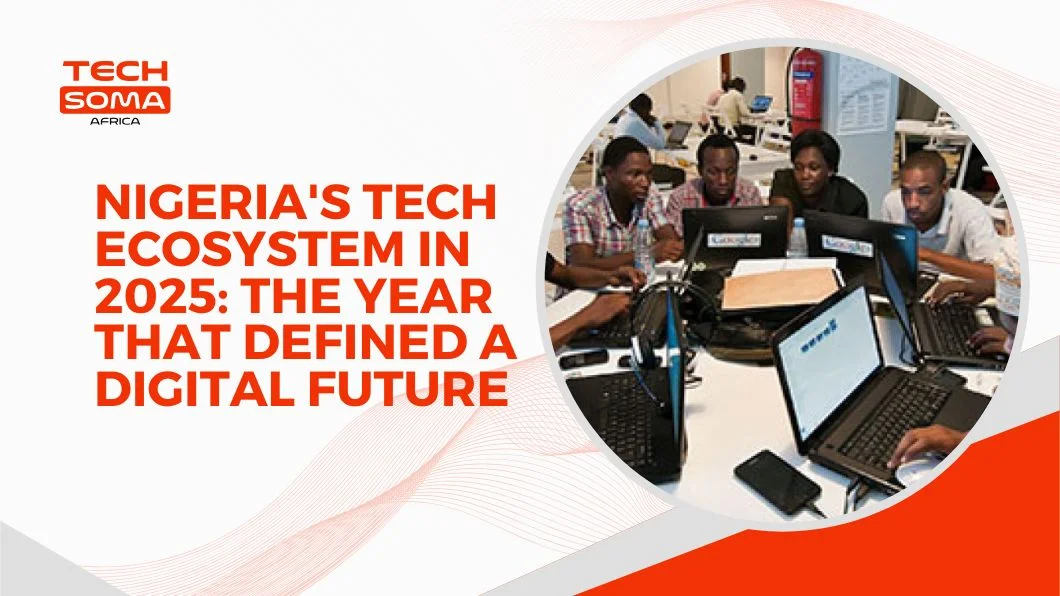
As 2025 draws to a close, Nigeria’s tech ecosystem has experienced a transformative year marked by major conferences, significant startup funding, and ambitious AI initiatives that signal the country’s growing influence in Africa’s digital economy. From Lagos to Abuja, the tech ecosystem has been buzzing with innovation, investment, and international recognition.

The Conference Circuit: Where Innovation Met Opportunity
Nigeria’s calendar was packed with high-profile tech events that drew thousands of participants and showcased the country’s growing tech maturity. Lagos Tech Fest brought together over 2,000 participants across multiple venues, including Four Points by Sheraton and Landmark Event Centre, featuring discussions on fintech, venture capital, crypto, and digital infrastructure. The event, headlined by Mastercard, combined networking with strategic conversations about the industry’s future through its exclusive Nigeria Tech Leadership Roundtable.
GITEX Nigeria made its debut with the theme “Forging the Rise of Digital Nigeria,” bringing together policymakers, enterprise executives, founders and investors across Abuja and Lagos. The September event focused heavily on government involvement in digital transformation, with the Abuja segment emphasising the Government Leadership & AI Summit, where discussions centred on building digital infrastructure and scaling AI readiness.
Perhaps most significant was DataFest Africa 2025, which brought together over 4,000 attendees, 50 speakers, and more than 30 sponsors in Lagos for a one-day festival focused on practical applications of AI and data science. The event highlighted data-driven solutions for finance, healthcare, agriculture, and public governance, with hands-on workshops exploring agent-based systems and ethical AI implementation.
MoonShot by TechCabal continued its reputation as the conference that sets the agenda for African tech, scheduled for October at the Eko Convention Centre, featuring startup pitches, workshops, and the TC Battlefield competition that gives emerging startups a global platform.
Funding Surge: Nigerian Startups Secure Major Investments
The funding landscape for Nigerian startups showed remarkable resilience in 2025. Nigerian fintech LemFi led with a $53 million Series B round to expand its remittance and cross-border payment services into Asia and Europe, demonstrating how local solutions are scaling globally.
Moniepoint processed over 1 billion transactions monthly early in the year, demonstrating rapid growth from 800 million in October 2024, following its $110 million Series C funding that achieved unicorn status. The company’s Vice President noted the growth reflected an expansion in the number of businesses served.
Other notable achievements included Middleman, which crossed N2 billion in Gross Merchandise Volume, launched Middleman AI with API integration, and received backing from Google while serving 12,000 users. The fintech company specialising in helping e-commerce entrepreneurs import from China and pay suppliers in RMB demonstrated the increasing sophistication of Nigerian cross-border solutions.
Kuda Nigeria also made headlines, processing over 300 million transactions worth N14.3 trillion in Q1 2025, while relaunching its cross-border remittance service with a multi-currency wallet.
Google’s Vote of Confidence: Nigerian Dominance in AI Accelerator
Perhaps nothing illustrated Nigeria’s tech leadership more than its performance in Google’s accelerator program. Nigeria secured six spots out of 15 startups selected for the Google for Startups Accelerator Africa Class 9, more than any other African country. The three-month program, running from June to August, offered up to $350,000 in Google Cloud credits alongside mentorship from Google engineers.
The Nigerian cohort included E-doc Online (compliance and credit intelligence), GoNomad (global business operations platform), Middleman (China-Africa procurement), Myltura (AI-powered digital health), Pastel (financial institution AI tools), and Scandium (AI quality assurance). These startups represent the diversity of Nigeria’s tech ecosystem, spanning fintech, healthtech, logistics, and enterprise software.
Government AI Initiatives: Building Infrastructure for the Future
The Nigerian government made significant moves to position the country as an AI leader. Nigeria launched a dedicated AI Research Scheme targeting startups and researchers with funding, mentorship, and collaboration opportunities. The program encourages solutions for agriculture, healthcare, security, and education using AI technologies tailored to local needs.
More ambitiously, N-ATLAS emerged as an open-source multilingual large language model fine-tuned on hundreds of millions of tokens of localised data, including Yoruba, Hausa, Igbo and Nigerian-accented English. Developed with Awarri and supported by the 3 Million Technical Talent (3MTT) initiative, N-ATLAS is positioned as a national digital public good, providing APIs and SDKs that reduce dependence on foreign AI systems.
The Broader Picture: Nigeria in Africa’s Tech Ecosystem
The year’s achievements must be viewed within the broader African context. Nigerian AI companies raised $47.3 million across 34 startups, though this trailed behind Tunisia’s $244.4 million across 9 companies and Kenya’s impressive capital efficiency. The data suggests Nigeria’s strength lies in ecosystem breadth rather than individual mega-rounds, with a focus on practical commercial applications.
January 2025 saw African startups raise $289 million, a 240% year-over-year surge, with fintech and cleantech together pulling in over $103 million. Nigerian startups featured prominently in these numbers, particularly in cross-border payments and financial infrastructure.
The Road Forward: Navigating Growth and Obstacles
Despite the progress, challenges remain. Infrastructure constraints, power reliability, and the need for more foundational AI research continue to limit long-term competitiveness. However, the concentration of talent, the government’s growing commitment to digital transformation, and the proven ability of Nigerian founders to build resilient business models position the country well for 2026.
As the year closes, Nigeria’s tech ecosystem has proven it’s helping to lead the African Digital Revolution. From the conference stages of Lagos to the code repositories building Nigeria’s AI future, 2025 will be remembered as the year Nigerian tech came of age, balancing local impact with global ambition.