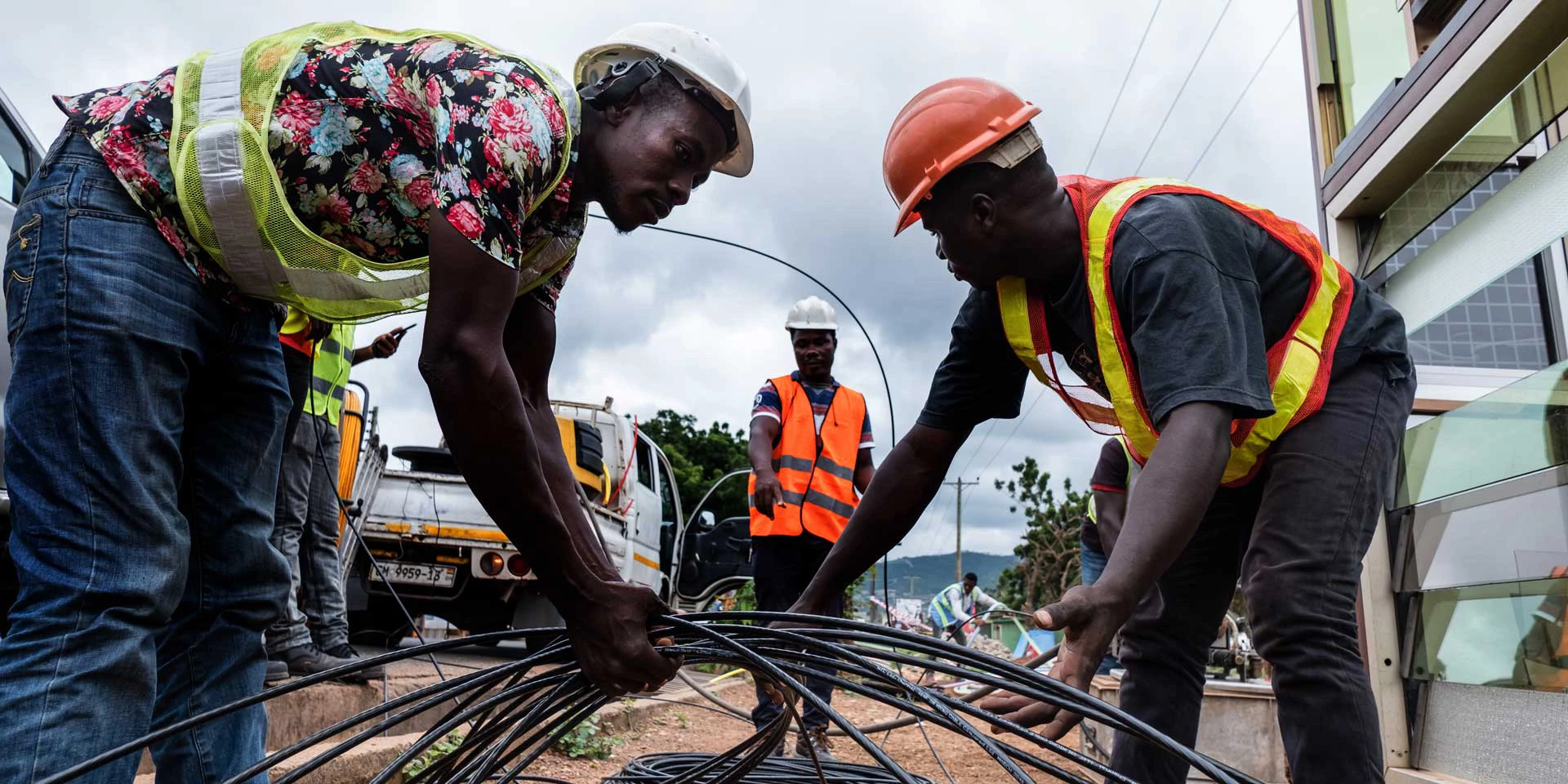
The African Development Bank Group has approved a $200 million loan to Nigeria to accelerate the rollout of a nationwide fibre-optic network, adding a significant funding milestone to one of Africa’s most ambitious digital infrastructure programmes.

The facility forms part of a broader $800 million sovereign financing package backing the Digital Value Chain Infrastructure for Boosting Employment initiative (better known as Project BRIDGE), which targets the deployment of 90,000 kilometres of open-access fibre across the country. The remaining sovereign funding comes from the World Bank ($500 million) and the European Bank for Reconstruction and Development ($100 million). When private sector capital and development grants are factored in, total project financing reaches an estimated $2 billion.
From 30,000 to 120,000 Kilometres
Nigeria’s fibre backbone currently spans roughly 30,000 kilometres, a figure that leaves vast portions of the country, particularly rural areas, without reliable broadband access. Project BRIDGE aims to deploy 90,000 kilometres of new open-access fibre, taking the national network to 120,000 kilometres and connecting all 774 local government areas, from schools and health facilities to agro-industrial zones and commercial hubs. The initiative is also expected to establish cross-border fibre links with Benin, Cameroon, Niger, and Chad, strengthening regional digital integration across West and Central Africa.
A Public-Private Structure Built for Scale
Project BRIDGE is structured as a public-private partnership through a Special Purpose Vehicle, with public ownership capped between 25% and 49% and private sector participation between 51% and 75%. This structure is designed to unlock institutional capital while keeping the government in a minority position, a deliberate choice aimed at insulating the project from the execution constraints that have historically plagued state-led infrastructure programmes in Nigeria, including high construction costs and right-of-way bottlenecks.
The partnership model also signals a broader policy direction from the Tinubu administration: positioning the state as a facilitator of digital infrastructure rather than its primary builder.
Jobs, Skills, and Broadband Penetration
The project is expected to generate up to 2.8 million jobs over its lifecycle and increase Nigeria’s broadband penetration from 45% to approximately 70% by 2030. Those figures, if realised, would mark a meaningful shift in Nigeria’s digital economy.
Beyond laying cable, Project BRIDGE includes demand-side interventions: funding will be channelled towards digital public services and the Three Million Technical Talent programme, aimed at building a pipeline of skilled digital professionals. Affordable device access and cybersecurity capacity are also embedded in the project’s design, along with renewable energy integration to improve network resilience.
Why This Matters
Nigeria’s digital economy has grown substantially over the past decade, but its infrastructure has not kept pace. Fintech, e-commerce, healthtech, and edtech platforms have all scaled in spite of the connectivity environment. A quadrupled fibre backbone changes the underlying conditions for every sector that depends on data.
The project aligns with Nigeria’s Renewed Hope Development Plan (2026–2030) and Vision 2050, and sits within the African Union’s Agenda 2063 framework. Whether the execution matches the ambition will depend heavily on how well the SPV is governed and how quickly right-of-way negotiations are resolved at the state level, historically a major sticking point in Nigerian fibre rollouts.