For decades, Nigeria has spent billions importing military hardware from China, Europe, and the United States, paying foreign prices, waiting on foreign timelines, and depending on foreign goodwill. That calculus may now be changing, thanks to a landmark deal between a homegrown defence startup and the Nigerian military’s own production arm.

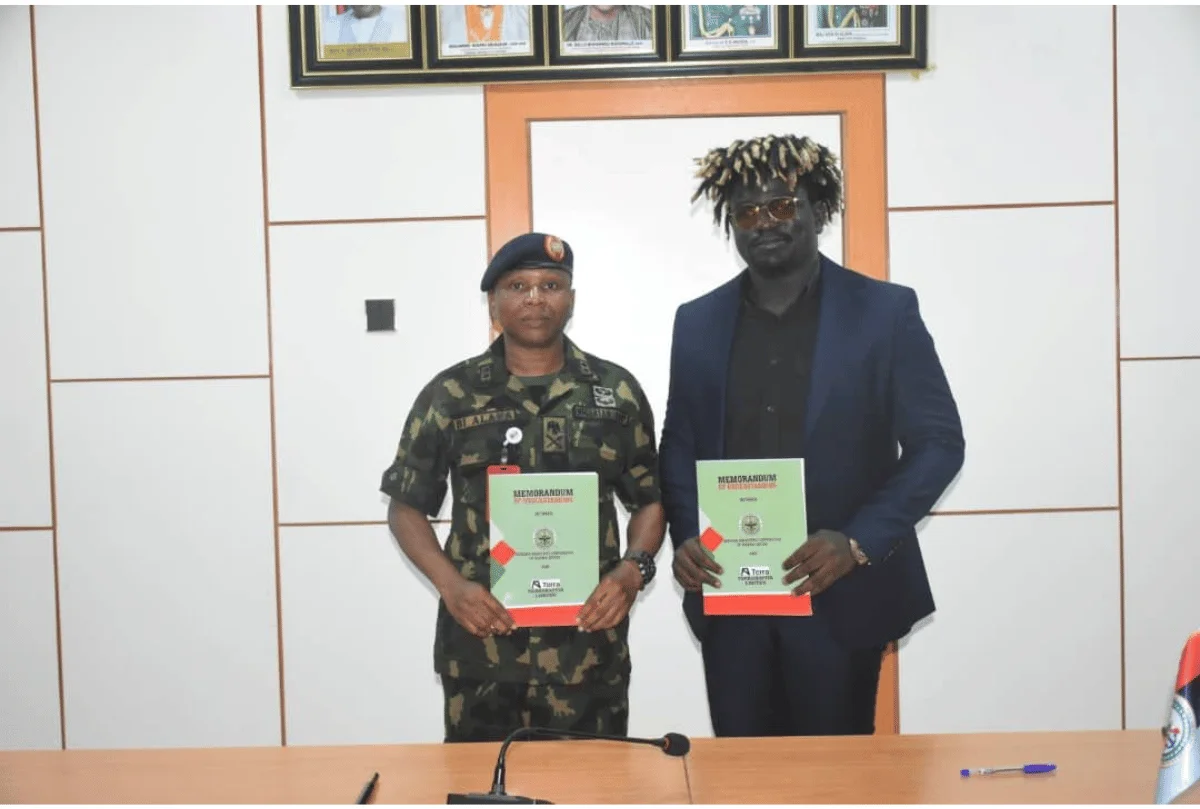
Terra Industries, an Abuja-based defence technology company founded just two years ago by 24-year-old Nathan Nwachuku and 26-year-old Maxwell Maduka, has signed a Memorandum of Understanding with the Defence Industries Corporation of Nigeria (DICON), the arms manufacturing body of the Nigerian Armed Forces. The agreement will establish a Joint Venture Company (JVC), jointly owned and operated by both parties, to build drones, robotics systems, and cybersecurity infrastructure right here in Nigeria.
What the Deal Actually Means
The JVC will handle assembly, research and development, and training of officers in the use of high-technology systems, including drones, robotics, cybersecurity infrastructure, and associated software. Beyond hardware, it will promote technology transfer, strengthen local sourcing of raw materials, and supply security equipment directly to Nigerian security agencies.
In plain terms, Nigeria intends to design, build, and maintain its own advanced weapons systems on home soil.
The Startup Behind the Deal
Terra Industries is not your typical defence contractor. About 40 per cent of its engineers previously served in the Nigerian military, while co-founder and CTO Maxwell Maduka is a former Nigerian Navy engineer who founded a drone company at age 19. The company already earns revenue, protecting assets valued at approximately $11 billion, including hydropower plants, mines, and power infrastructure, mostly in Nigeria.
The startup has also caught serious international attention, raising $34 million in total funding from investors including Lux Capital, 8VC, and Resilience17 Capital. This is a signal that global defence investors believe Africa is ready to be taken seriously in this space.
Why This Matters for Nigeria
Nigeria’s security challenges are well-documented: insurgency in the North-East, banditry in the North-West, oil theft in the Delta, and persistent infrastructure attacks across the country. Nigeria has historically purchased military equipment from foreign suppliers, including drones from China, Turkey, and the United States, as well as armoured vehicles from Europe. This leads to long procurement wait times, high costs, vulnerability when suppliers impose restrictions, and a limited ability to maintain equipment without foreign support.
The Terra-DICON deal is a direct answer to that vulnerability. If it delivers on its promise, Nigeria could stop being a customer and start being a manufacturer — and potentially an exporter.
The agreement is being executed under the DICON Act 2023, which expanded the corporation’s powers to collaborate with private and foreign firms through public-private partnerships. It builds on a wave of recent DICON activity, including partnerships to locally manufacture drones and satellite systems with other firms.
Nigeria has long been told it cannot build what it needs. Two founders in their twenties, a military corporation, and a $34 million war chest are betting otherwise.