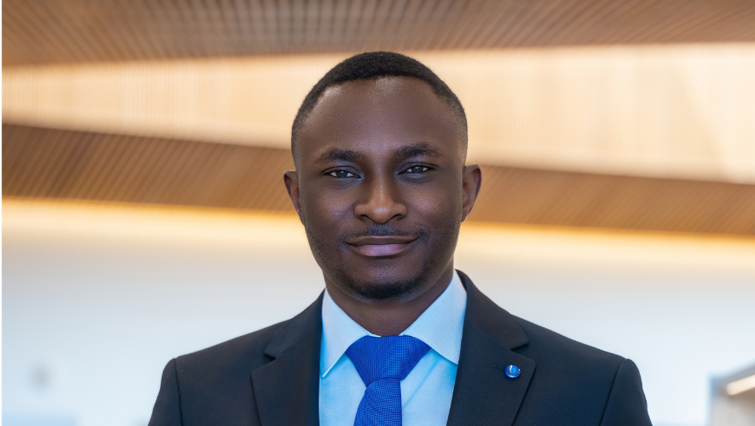
Michael Adekunle is only in his second year of medical school, yet his footprint across public health, health-tech innovation and medical research is already impossible to ignore. I sat down with him for an in-depth conversation about his journey, the birth of the Super Medic Initiative, and the maternal health solution that earned him global recognition.

This is the story behind the work, told in his own words and shaped through our interview.
A Childhood That Sparked a Lifelong Curiosity
Michael began by introducing himself as a second-year medical student at the College of Medicine, University of Lagos. His interest in healthcare did not appear suddenly. Instead, it was formed through years of repeated hospital visits as a child, shaped by interactions with doctors and driven by a mother who battled various health issues.
Those experiences created a sense of responsibility in him. Healthcare, for him, was never abstract. It was personal. It was urgent.
His early exposure to a tech-inclined roommate and an elder sister involved in technology later connected the dots between medicine and innovation. At first, he had no plans to pursue health tech. But that changed when he encountered problem-solving opportunities on campus.
Where Conversations Turned into Action
Michael’s entry point into structured innovation came through the Association of Medical Students, Lagos. During the organisation’s annual LT programme, he participated in a competition which challenged students to design solutions for emergency medicine in Nigeria.
His team won.
That win became a turning point. Guided by mentors, he began to treat innovation not as an extracurricular activity but as a discipline worth pursuing.
At the same time, discussions with his father about gaps in Nigeria’s public health system stirred a deeper desire to build something practical, something that could improve access to basic care.
That was the seed that became the Super Medic Initiative.
How the Super Medic Initiative Took Shape
In July, Michael and a close colleague officially launched the Super Medic Initiative. Their goal was simple yet ambitious: drive change within communities rather than wait for the system to catch up.
The initiative now focuses on four areas:
-
Public health advocacy
-
Medical research and innovation
-
Health innovation
-
Girl-child advocacy
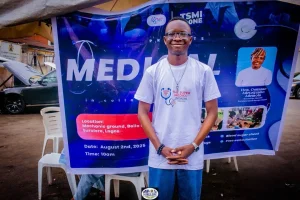
In a few months, it has delivered six to seven medical outreaches and impacted over 1,000 people. Each outing deepened Michael’s understanding of the challenges facing vulnerable populations, especially the knowledge gaps, delays, and access barriers that turn treatable conditions into crises.
Building a Maternal Health Lifeline
Our discussion shifted to his recent achievements, the hackathons that brought significant recognition.
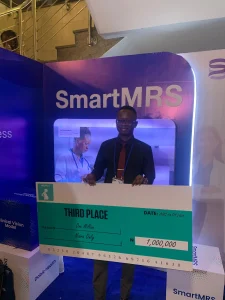
The first was the Smart MRS Competition. Out of over 400 innovators, Michael’s team emerged third and won funding to advance their work.
The second was the Cyber AI Hackathon hosted by the University of Derby, UK. Against international teams, his group won the Innovation Prize.
But what impressed me most was the product itself.
The team built a voice-enabled maternal emergency response system. It addresses the three delays associated with maternal mortality: recognising danger, reaching healthcare facilities and receiving adequate care.
Key features include:
-
A voice assistant that supports local Nigerian languages
-
Real-time visibility into hospital bed spaces and facility availability
-
A unified communication network between families and health centres
Michael explained that emergencies leave no time for typing or navigating complex apps. Voice input removes that barrier. The solution remains in active development, and his team plans to scale and pilot it.
A Student Balancing Medicine, Research and Innovation
When asked how he manages medical school alongside innovation, he responded with honesty: “Balance is an illusion.”
He believes true balance is unrealistic, but prioritisation is not. He modifies his study routine, limits unnecessary commitments and leans on a competent team that understands the mission.
His track record shows this clearly. He was the first 200-level student to present at the Surgical Interest Group Lagos conference, winning the Audience Choice Award for his research abstract. He remains active in research, public speaking and debate, yet maintains a strong academic focus.
His motivation is simple: this is who he is. Innovation is not a distraction from medicine; it is part of the identity he refuses to lose.
A Message to Medical Students Afraid to Explore Beyond the Classroom
Near the end of our conversation, we discussed a challenge many young medical students face: the fear of stepping beyond textbooks and clinics.
Michael’s advice was clear. He believes the healthcare space is vast, and not all solutions live within hospital walls. Students should reflect on what they find meaningful, identify the problems they want to solve and expose themselves to opportunities offered by their medical student associations.
He emphasised the power of mentorship. Being around purpose-driven people changed the trajectory of his own journey, and he encourages others to seek environments that stretch their thinking.
For him, innovation is not about abandoning academics. It is about expanding what it means to be a future doctor.
A New Kind of Medical Student
My interview with Michael revealed a young innovator redefining what is possible for students in Nigeria’s medical schools. His work reflects a new generation that refuses to wait for change.
Instead, they build it.