

Ayo (Nafiu) Adisa is a Senior Systems and Business Analyst with over a decade of experience delivering transformative solutions across fintech, financial services, and insurance. Skilled in systems design, enterprise architecture, and a wide range of technical tools, he bridges the gap between business needs and technical execution. Ayo is passionate about driving innovation, enhancing interoperability, and shaping enterprise-wide digital strategies that deliver long-term impact.
As the world evolves and becomes more linked, the ability and capacity of systems to communicate with each other without any problem has become a vital aspect of digital transformation; hence, bringing about the need for Interoperability. Interoperability is the capacity of computer systems or software to exchange and utilise information. However, this is no longer a luxury, rather it has become a must-have for everything that impacts our daily life activities as it spans across Health Care, Education, e-Governance, Finance, Entertainment and many more sectors. It is important to acknowledge that open standards are at the centre of this change, and they are changing the way global IT systems are built, used, maintained and scaled.
As a Senior Systems Analyst with years of in-depth experience and working on various systems, I have seen how systems’ incompatibility and not being able to work together can stifle new ideas, drive up expenses with respect to scalability and maintenance, which could make the user experience (UX) worse. Conversely, systems designed on open standards can be more efficient, collaborative, scalable and most importantly drive up the quality of UX. This article talks about the shift towards interoperability around the world, the role of open standards, and how Africa, especially Nigeria, is getting ready for this digital revolution.
What Is Interoperability and Open Standards?
Interoperability can be described as the ability of multiple IT systems, applications, and devices to exchange and understand their individual data sets. It makes sure that systems or services made by multiple organisations or service providers can function together with minimal changes required to achieve set goals or objectives.
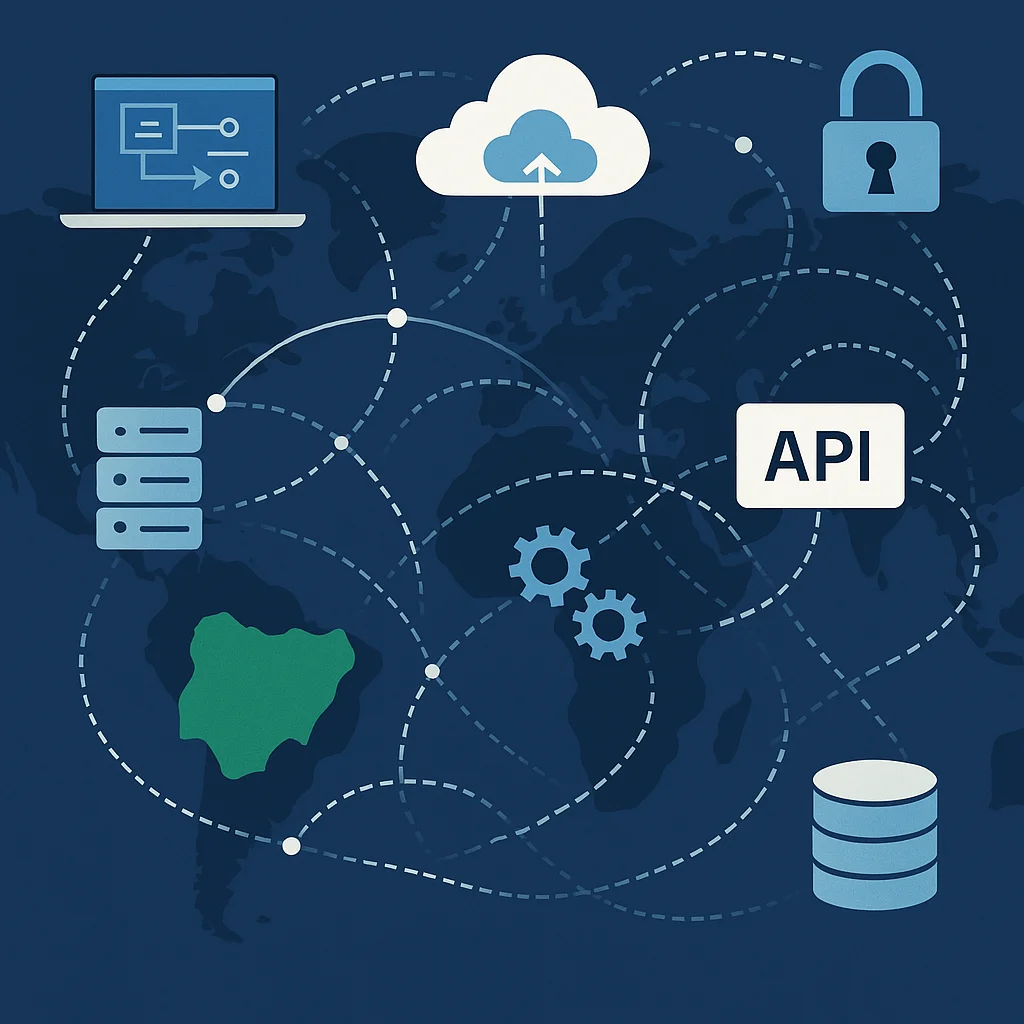
To seamlessly achieve any set goals with minimal changes, then open standards is the key. Open standards are publicly published rules that make sure things or processes such as systems work together. Open standards are made by a group of people who agree on them, and they are so accessible that anyone can use them, this includes but not limited to ISO 20022 commonly used in payment and financial institutions, HL7 commonly used in health care institutions while MPEG, GLTF and OpenEXR are popularly used in the entertainment industry. Nonetheless, it is important to note that the aim of open standard is to encourage transparency, generation of ideas, and collaboration among various service providers or organisations. Although, this aim has already been incorporated into most organisations’ operational foundation but the need to grow on it has become vital.
Why Is Interoperability More Important Than Ever?
- Digital Services Globalization: As firms or organisations scale to meet global standards or needs, it has become crucial for these firms or organisations to implement technologies that enable communication across borders irrespective of their physical presence. Interoperability therefore becomes the cohesive force that integrates global digital ecosystems, ensuring the seamless exchange and utilisation of data, whether it involves a fintech or eCommerce connecting with a payment gateway far away from its physical location or a citizens data platform in Nigeria synchronising with United Kingdom (UK) voting systems as commonwealth countries.
- The advancement of hybrid and multi-cloud environments: Various sectors that answer to everyday life needs are gradually and at a fast pace entrusting cloud services-oriented techniques. Without open standards, it becomes a technological challenge to integrate services across cloud-based service providers such as Amazon Web Service (AWS), Azure, Digital Ocean, Google Cloud Platform (GCP) and more. Open APIs and recognised standards make this complexity easier to handle.
- Digital Public Infrastructure (DPI): Governments are investing in DPI, which includes essential digital infrastructure like digital identification, payment platforms, and data exchanges. Notable instances encompass UK residents or citizens records with financial institutions, health institutions or law enforcement outfits. Interoperability must be an inherent design feature from the beginning for Africa to develop analogous infrastructure.
Case Studies
- Interoperability within the Financial Sector: Financial services exemplify the transformative impact of open standards on global systems. The Atlantic Council asserts that strong, scalable, and rapid interoperability standards are essential for the development of digital currency, including Central Bank Digital Currencies (CBDCs). Also, mobile money platforms such as MTN MoMo in South Africa, Paga in Nigeria, and M-Pesa in Kenya have transformed financial inclusion across Africa. Due to incompatibility across various platforms, customers are devoid, limiting them to maintain multiple account profiles. Hence, initiatives such as the Pan-African Payment and Settlement System (PAPSS) aim to address this issue by establishing a uniform payment system that enables an efficient and secure flow of money across African borders. This has become one of PAPSS’s core functions till date.
- Nigeria’s Interoperability Journey: Nigeria, the leading economy in Africa, is advancing in the implementation of open standards, especially within the public and financial sectors, which encompasses several initiatives:
- National Identity Management Commission (NIMC): NIMC has established open application programming interfaces (APIs) to let financial institutions, telecom providers, and internet firms verify customers’ identities. This is a step in the right direction towards a more inclusive and compatible digital identity ecosystem.
- Framework for Open Banking: With the launch of the Open Banking Framework in 2021, the Central Bank of Nigeria (CBN) mandated the use of standardised APIs by the banking industry and financial technology companies. As a result, more innovation, customer-centric services, and healthy competition are expected.
- Health and Education Systems: The level of interoperability in health and education sectors is also on the rise. Electronic medical and educational records are being standardized across hospitals and schools by various platforms such as Nigeria’s National Health Management Information System (NHMIS). The education sector is exploring initiatives aimed at sharing educational records amongst schools, for example EXT.NG, which allows students, alumni, academic institutions, and employers to request, verify, and share digital credentials in a simple and secure way.
Challenges to Achieving Interoperability
- Confusing and Incompatible Standards: Multiple standards exist for the same function, complicating comprehension. For example, in the financial sector, a bank may use ISO20022 for processing foreign payments, while the receiving bank uses Swift Message Type (MT) forms, causing incompatibility unless further adjustments are made.
- Vendor Lock-in: Legacy systems hinder interoperability with other systems, limiting market competitiveness and often requiring supplementary APIs to integrate with internal systems. This can be costly.
- Not Enough Policy Alignment: Governments often lack the regulations necessary to ensure interoperability across diverse technologies, leading to fragmented systems that cannot communicate effectively.
- Skills Gap: There is a shortage of individuals with the knowledge to implement standards-based design and systems thinking.
The Way Forward
- Rules and Policies: Governments should mandate the use of open standards in public procurement and digital infrastructure initiatives. South Africa’s use of Open Document Standards within government is an example.
- Building Capacity: Educational institutions and professional organisations should train IT workers, especially aspiring Systems Analysts, on interoperability frameworks such as RESTful APIs, e-Governance standards, and ISO 20022.
- Public and Private Sector Collaboration: IT enterprises, regulators, and civil society must collaborate to establish standards that reflect innovation and the public interest, similar to how GDPR and privacy standards were developed in Europe.
- Community Driven & Open-Source Innovation: Open-source projects like Linux, Kubernetes, Apache Kafka, OpenEMIS, and OpenAPI lead in interoperability due to community backing and established guidelines.
In Conclusion: Interoperability is not only a technical objective; it is essential for strategic economic advancement. IT professionals serve as intermediaries between technical implementation and real-world requirements, ensuring systems are accessible, inclusive, and future-ready. To thrive in the global digital economy, Nigeria and Africa must ensure that any system designed is compatible with others.















So insightful, lovely write up.
Apt 👍