


Cloud infrastructure giant Vercel has confirmed unauthorized access to its internal systems, sparking fears of a massive, global supply chain attack. While Vercel’s official statement limits the blast radius to a “subset of customers,” the threat actor claiming responsibility—ShinyHunters—is demanding a $2 million ransom to stop them from weaponizing Next.js against developers worldwide.
With Next.js seeing 6 million weekly downloads globally, the implications of this breach extend far beyond a standard data leak.
The Threat: A Poisoned Next.js Payload
ShinyHunters claims to possess internal deployment access, source code, databases, and critical tokens (API, NPM, GitHub). Their primary threat is extortion: pay the $2 million USD (starting with $500k in Bitcoin), or they will push a malicious payload disguised as a routine Next.js update.
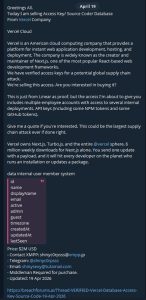
If executed, this would instantly compromise applications across the globe, turning the web’s most popular React framework into a Trojan horse.

The Disconnect: PR vs. Reality
There is a glaring gap between Vercel’s PR response and the hackers’ claims. Vercel states the impact is limited, and systems remain operational. However, their official recommendation for customers to “review environment variables” is a massive red flag.
Environment variables are where development teams globally store their most sensitive production secrets—AWS credentials, Stripe API keys, and database passwords. If ShinyHunters accessed these, the fallout will affect SaaS platforms, e-commerce giants, and enterprise infrastructures everywhere.
READ ALSO: CAC Under Cyber Attack: Smart Steps to Secure Your Business Records Today
Immediate Action for Global Engineering Teams
Regardless of Vercel’s assurances, global engineering teams must operate under a “zero trust” assumption regarding their current Vercel deployments:
-
Rotate All Secrets Immediately: Revoke and regenerate all critical API keys, database passwords, and tokens stored as environment variables on Vercel.
-
Audit External Access: Check logs across all connected services (cloud providers, payment gateways) for unauthorized queries originating outside your normal infrastructure.
-
Pause Updates: Freeze non-critical Next.js version updates until Vercel provides absolute technical verification that their NPM and GitHub deployment pipelines are fully secure.
The web relies on Vercel. Until the full scope of the ShinyHunters breach is verified, the global developer ecosystem remains in the crosshairs.