
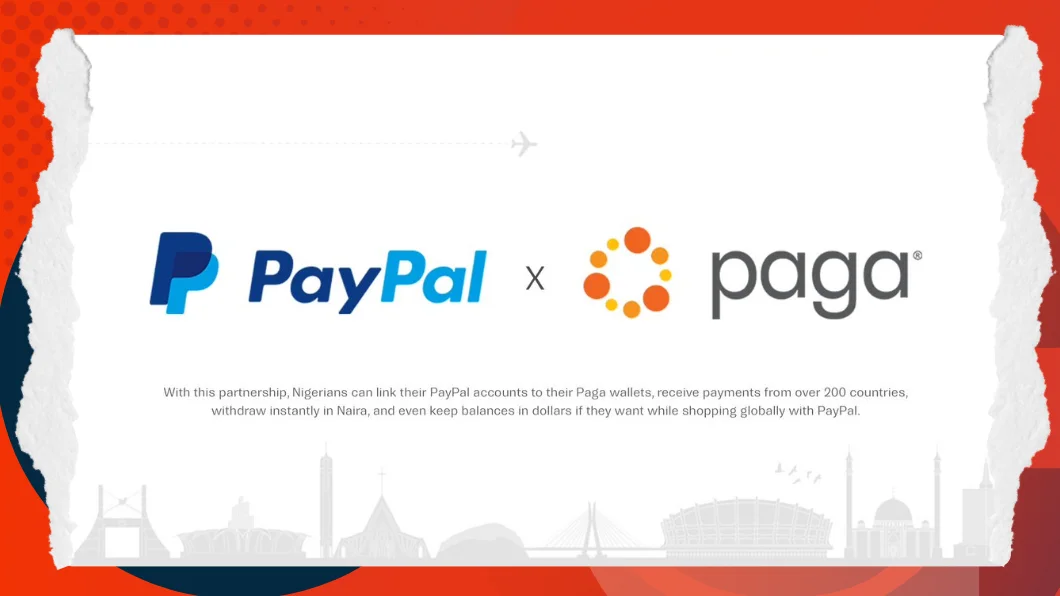
PayPal can now be used in Nigeria in a way Nigerians have waited for: receiving money. Through a new integration with Paga, Nigerian PayPal users who link their PayPal account to Paga can receive international payments via PayPal and withdraw into naira locally.

It is the latest chapter in a long, uniquely Nigerian payments story: global demand rising, local talent going global, and the country’s fintech ecosystem building bridges where global rails were limited, with Paga steadily expanding its role as that bridge, including support for Meta’s WhatsApp ads payments.

The missing decade: PayPal in Nigeria, but not fully
PayPal’s relationship with Nigeria has been complicated for more than a decade. PayPal expanded services to Nigeria in 2014 amid concerns about fraud risk in new markets, and the rollout was widely understood as limited rather than full parity with mature markets.
For years, a core constraint remained: many users in certain regions could use PayPal to send payments, but not receive them, a reality PayPal itself explains as tied to the complexities of global finance.
The impact was practical. As global clients increasingly preferred PayPal for cross-border payments, Nigerian freelancers and businesses faced friction receiving earnings through the same channel that much of the world used by default.
The Nigerian workaround economy, and the fintechs that formalised it
That gap created a market. Nigerian and African-focused fintechs rose to meet demand from freelancers, creators, remote workers, and businesses selling internationally.
Raenest, launched in 2022, built multi-currency accounts and tools to help Africans receive international payments and manage foreign currencies.
Grey, founded in 2021, positioned itself around virtual international bank accounts for receiving foreign payments, targeting the same pain point.
Payday, also founded in 2021, raised funding on the thesis of powering the future of work for African remote workers with cross-border accounts and payouts.
This was the broader context behind the excitement around any meaningful PayPal unlock: Nigeria’s market demand was never in question. Access was.
Why PayPal still matters, even in a world of alternatives
Even with strong local alternatives, PayPal remains structurally important because of its global footprint and buyer familiarity.
In 2024, PayPal reported 434 million active accounts, processed $1.68 trillion in total payment volume, and handled 26.3 billion payment transactions. (SEC)
That scale matters when Nigerian talent is selling to international clients and Nigerian businesses are trying to convert international customers. In many global workflows, PayPal is still the default checkbox.
What has launched with Paga
Paga and PayPal have launched live account linking in Nigeria, enabling users to:
- Link PayPal to a Paga wallet
- Receive international payments via PayPal
- Withdraw funds locally in Naira through Paga
Paga’s founder, Tayo Oviosu, has framed this as a long arc that began with outreach to PayPal in August 2013, proposing that Paga could provide on ramps and off ramps for PayPal in Nigeria.
Paga’s role: quietly building the local layer
Paga is not new to this kind of infrastructure work. Founded in 2009, it has spent years building payment distribution and wallet utility in Nigeria, including an agent network and broad usage for transfers and bill payments.
Paga is beginning to emerge as a partner for global companies looking to play in Nigeria’s ecosystem. The Paga currently provides payments infrastructure for Meta’s WhatsApp ads as well as other platforms.
This matters because partnerships like this tend to favour companies that already understand local KYC realities, settlement behaviour, and support load at scale. The Paga PayPal link is best read as a global platform plugging into an established local layer rather than attempting to reinvent one.
What this unlocks for Nigerians
A cleaner payment path for global work
For freelancers, creators, consultants, and remote employees, this creates a more direct route from PayPal earnings to naira liquidity, without the usual friction and improvised workarounds.
Stronger trust for cross-border commerce
For merchants and service businesses, PayPal acceptance can increase conversion with international customers who already trust PayPal. The partnership messaging explicitly leans into global reach and local access.
A signal about how global platforms will scale in Africa
This reinforces a pattern: partnerships with regulated local rails are becoming the pragmatic way for global platforms to expand functionality in complex markets.
What to watch next
Reliability and support under real volume
Nigeria will judge this on success rates: linking, withdrawals, reversals, dispute handling, and customer support responsiveness.
Pricing, FX spreads, and withdrawal experience
If the user economics are not competitive, alternatives will remain attractive even with PayPal’s brand.
Competitive responses
Expect other wallets and cross-border platforms to respond with pricing pressure, product bundles, or new partnership routes to capture the same “global earnings to local spend” flow.
What to take away
This launch connects PayPal’s global acceptance to local naira access through a Nigerian wallet that has spent years building domestic payments infrastructure.
For a market that has long had to innovate around limited PayPal functionality, that shift is practical, immediate, and likely to be widely adopted if execution holds.