

In a business environment where corporate success is too often measured by the size of funding rounds and the noise around valuations, Payaza Africa’s latest achievement offers a more sober and instructive metric. Global Credit Ratings (GCR), an affiliate of Moody’s, has upgraded the company’s long-term credit rating from BBB– to BBB, maintaining its investment-grade status while strengthening its standing in the eyes of local and international investors.

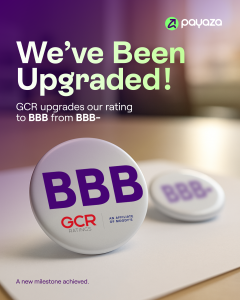
On the surface, a one-notch upgrade may seem modest. In reality, within the conservative world of credit analysis, it signals something far more substantial. It reflects not just promise, but performance; not mere ambition, but verifiable discipline. For a relatively young African fintech operating across 21 countries, this represents a significant vote of confidence in its underlying fundamentals.
What makes this development even more noteworthy is that it does not stand in isolation. Payaza already enjoys investment-grade ratings from DataPro and Agusto & Co., two highly regarded rating agencies in Nigeria and across Africa. The convergence of these three independent assessments is important. It means that different institutions, applying their own models and stress scenarios, have reached a similar conclusion: that Payaza is a credible, well-governed, and financially sound institution in a sector often associated with volatility and speculation.
This is a remarkable differentiation in a crowded fintech landscape. Many operators in the space are known largely for the size of their last equity raise or the speed of their expansion. Payaza, by contrast, is increasingly distinguished by something less glamorous but far more enduring: a balance sheet and cash flow profile that can withstand scrutiny.
At the heart of GCR’s upgrade is the company’s performance under its ₦50 billion Commercial Paper Programme. In December 2024, Payaza issued its first and second tranches under this programme. The first tranche, amounting to ₦14.97 billion, was repaid in full and ahead of schedule by June 2025. The second tranche of ₦5.36 billion, which matured in September 2025, has also been settled ahead of time. This early redemption, funded entirely from internally generated revenue rather than fresh equity, venture capital, or stop-gap bridge financing, is a critical signal. It demonstrates a business model that generates real cash, not just impressive projections.
READ ALSO: $10M In, $10M Out, 0% Equity Lost: Payaza’s Debt Play Signals a New Era for African Startup Funding
In the context of emerging markets, where restructurings, rollovers, and quiet date extensions are not uncommon, early repayment at this scale is exceptional. It sends a clear message to the market: this is a company that takes its obligations seriously and manages its liquidity with prudence.
For rating agencies, such conduct carries more weight than any marketing narrative. It tells a story of internal controls, treasury competence, and governance standards that go beyond what is typical for a young technology-driven firm. GCR’s recalibration from BBB– to BBB is therefore not a gesture of goodwill, but a considered response to evidence.
It is also important to locate this achievement within the broader evolution of Payaza’s business. From its origins in Lagos, the company has grown into a financial infrastructure provider with operations in 21 countries, supporting small and medium-sized enterprises, traditional merchants, digital-first startups, and immigrant-owned businesses. Its infrastructure underpins payment collections, cross-border disbursements, and embedded finance through APIs that connect African markets to themselves and to the wider world.
In 2024, Payaza undertook a comprehensive rebrand to reflect its transition from a regional payments processor to a global financial infrastructure player. Rebrands of this sort are common in the technology sector and are frequently cosmetic. In Payaza’s case, the subsequent pattern of strong credit performance and multi-agency investment-grade ratings has effectively validated the new positioning. The brand now has behind it the kind of independent, risk-based endorsement that sophisticated partners and institutional investors look for.
For Nigeria and the continent, this development carries implications that go beyond the fortunes of a single company. First, it challenges persistent stereotypes about African fintech as inherently high-risk and structurally fragile. Here is a Nigerian-born company that has not only scaled across borders but has also subjected itself to the discipline of the capital markets and emerged with an enhanced rating profile.
Second, it provides a useful example of how African firms can move from being evaluated purely on potential to being judged on consistent delivery. The comments of Payaza Africa’s Chief Executive Officer, Mr. Seyi Ebenezer, are therefore well placed. According to him, “the GCR upgrade is an endorsement of both Payaza’s internal governance and Nigeria’s ability to produce globally relevant, financially sound fintech operators. A claim that is too often made in aspirational terms, but now rests on tangible evidence, thanks to Payaza.
Third, the upgrade materially improves Payaza’s access to capital and partnerships. A stronger investment-grade rating typically translates into better pricing for debt instruments and greater comfort for institutional investors bound by internal risk limits. It also enhances the company’s credibility with multinational partners and regulators, many of whom must make careful choices about which private players to trust with essential aspects of financial infrastructure.
For the Nigerian financial system, the emergence of fintech institutions with this level of creditworthiness is a positive development. It suggests that innovation and prudence need not be mutually exclusive, and that technology-led firms can mature into stable, long-term actors in the market. In an era when the stability of payment systems, cross-border remittances, and merchant acquiring has direct implications for economic growth, such institutions are not merely desirable; they are necessary.
None of this is to suggest that Payaza, or any other African fintech, is immune to risk. Macroeconomic volatility, regulatory shifts, foreign-exchange pressures, and political uncertainty remain significant factors in many of the markets where these firms operate. A BBB rating is not a certificate of invulnerability. It is, however, an indication that the company is better positioned than most to navigate such headwinds.
The larger point is that the conversation about African technology companies must evolve. For too long, they have been assessed largely through the lens of venture capital, with success equated to valuation milestones and funding announcements. Payaza’s trajectory suggests a different benchmark: the ability to meet obligations, to manage risk, to command trust from conservative capital, and to win the confidence of multiple rating agencies.
In that sense, this credit upgrade is more than a corporate headline. It is a marker of quiet institutional progress. It signals that African fintech is capable not only of scaling rapidly, but also of growing up, and adopting the disciplines, standards, and transparency traditionally associated with established financial institutions.
For Nigeria, this is a welcome narrative. For Africa’s broader financial ecosystem, it is a signal that the continent is not merely consuming global financial models, but it is steadily producing institutions that can stand alongside their global peers on the strength of their numbers, not just their stories.