
Nigeria’s first nationwide incubation programme, known as iHatch, has opened applications for its 2026 Cohort 5 incubation programme. The new call targets early-stage founders who want to move an idea into a working product, test that product in the market, and get ready for funding. The programme runs through a hub-first model that covers all 36 states and the FCT, which gives it a wider reach than many startup support programmes in the country.
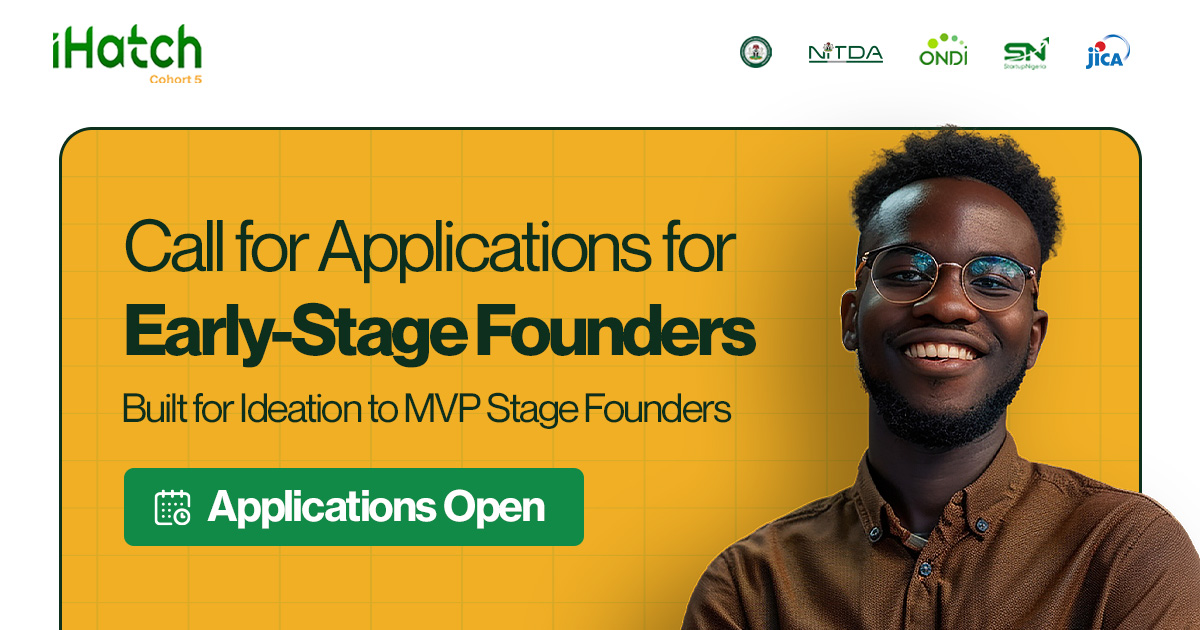
Most startup attention in Nigeria still clusters around Lagos and Abuja. That leaves many founders outside those cities with fewer mentors, weaker local networks, and less access to structured support. iHatch says it wants to change that pattern. The programme describes itself as a nationwide incubation effort built on a decentralised, hub-first model. Instead of working with founders in a few strong cities, it works through innovation hubs across the country and aims to build long-term local support systems.
NITDA, through the Office for Nigerian Digital Innovation, wants one innovation hub in each of Nigeria’s 36 states and the FCT to help run the programme locally. Victoria Fabunmi, ONDI’s national coordinator, said structured support remains uneven outside the main tech clusters. That point matters because many founders do not fail on the idea alone. They fail because they build without guidance, customers, or a support system close to home.
The programme focuses on building
The startup track for Cohort 5 runs for four months and focuses on execution. That matters in today’s funding climate because investors now ask tougher questions about product use, revenue plans, and team strength. iHatch says founders in the programme will work on MVP development, legal incorporation, market validation, sector-focused training, mentorship, and demo day preparation. The official programme page also highlights funding and market opportunities, which offer teams more than just classroom sessions.
The iHatch structure runs longer than the startup window alone. ONDI says the full cycle lasts 10 months, with five months for hub training and five months for startup incubation. That design shows the real idea behind the programme. iHatch does not treat founder support as a short burst of activity. It tries to improve the local institutions that founders rely on before and after the incubation period.
In its 2024 Africa Tech VC report, Partech said African startups raised $3.2 billion in equity and debt funding, down 7 percent year-on-year. The firm also said Series A and B deal flow slowed, fundraising took longer, and extension rounds increased. At the same time, seed activity held up better, and seed ticket sizes grew. For early-stage founders, that points to a simple truth. Investors still back good companies, but they want more proof before they commit.
Nigeria still has momentum, but founders need stronger basics
Nigeria remains one of Africa’s busiest startup markets. Partech said the country led the continent in 2024 equity funding with $520 million and 103 equity deals. That shows investor interest remains strong. Yet strong deal numbers do not solve the early-stage gap across the country. Many founders still need help with customer discovery, team structure, product testing, and legal setup before they can even pitch serious capital.
African startups raised $3.42 billion in 2025, up 53 percent over 2024. That rebound shows capital still flows into the continent. Even so, the lesson for founders has not changed. Growth stories now carry more weight when they come with a working product, visible traction, and a clear path to scale. Programmes like iHatch fit that shift because they push founders to build first and sell the story later.
The local hub model gives iHatch an edge
Many incubation programmes focus only on the startup batch. iHatch takes a different route. It trains hubs, ranks them, monitors progress, and then uses those hubs to support founders at the state level. ONDI says this model creates stronger regional capacity, supports inclusion in underserved areas, and encourages long-term collaboration among startups, hubs, government, investors, and ecosystem partners. That matters because one strong local hub can keep helping founders long after one cohort ends.
Selected hub managers will recruit and guide startups in their states for at least one year. That gives the programme a longer support horizon than many founder competitions or pitch events. It also suggests that iHatch wants local continuity, not a one-off burst of publicity.
Founders need to show readiness, not just ambition
The eligibility rules for the startup call set a clear tone. Applicants must be at least 18 years old, based in Nigeria, and apply as a team of at least two people. Each team needs at least one full-time member with technical capacity. The startup must sit at the idea, prototype, or MVP stage, and the team must commit at least 10 hours a week during the four-month programme. Selected teams will also submit progress reports and work with assigned innovation hubs.
Those rules do two useful things. First, they screen out casual applicants. Second, they push teams to show they can execute. The evaluation criteria also reflect that mindset. iHatch says it will assess innovation, market potential, feasibility, team capability, and impact. That is a solid checklist for any founder, even outside this programme. A good early-stage startup needs more than a bold pitch. It needs a clear problem, a product plan, and a team that can keep shipping.
This call fits the market that founders face now
Money has not disappeared from African tech, but investors now reward discipline more than noise. Teams that build a useful MVP, validate demand, and stay close to the customer have a better shot at surviving and raising capital. iHatch leans into that reality. It offers structure, local support, and a path to investor readiness without pretending that funding alone solves startup problems.
For Nigeria’s startup scene, the biggest value in this programme may sit outside the batch itself. If iHatch helps local hubs work better and helps founders build with more discipline, it can improve the quality of startup support across the country. That would give more builders a fair shot, not just the ones already close to the loudest tech circles.