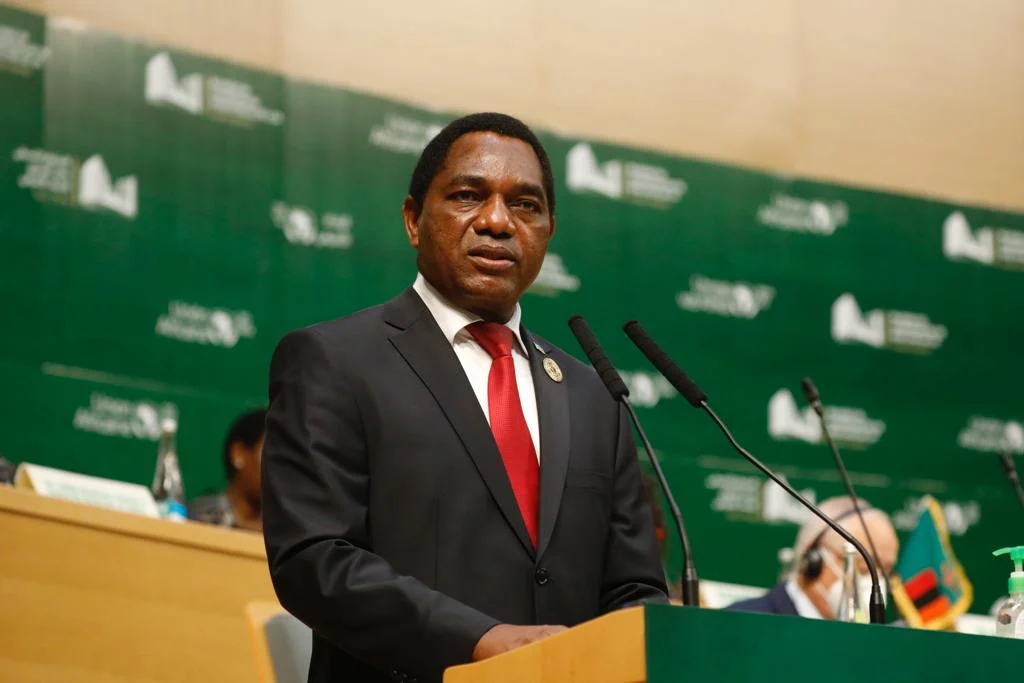
The government of Zambia has declared the misuse of artificial intelligence-generated content a national security threat, as authorities move to curb rising misinformation ahead of the country’s 2026 general elections.

The announcement reflects growing concern that AI tools are being used to distort public information, manipulate narratives, and undermine trust in state institutions at a politically sensitive moment.
Election tensions meet AI-driven misinformation
Officials say the spread of AI-generated content has intensified in the lead-up to the August 2026 elections, raising fears about its impact on governance and public stability. Hakainde Hichilema’s administration has faced criticism from some quarters, with opponents arguing that recent regulatory actions risk limiting media freedom even as the government frames them as necessary safeguards.
According to government representatives, distorted versions of official statements and policies are circulating online, creating confusion and eroding public trust.
Authorities warn that such misinformation could disrupt key sectors, including health, education, and economic planning, particularly if widely believed or amplified through digital platforms.
Regulators step in as risks expand
The response has included heightened regulatory activity by the Zambia Information and Communications Technology Authority, which has taken enforcement actions in recent weeks, including the provisional shutdown of several radio stations in the Copperbelt region.
While the regulator cited technical interference with aviation systems as the immediate reason, the broader context points to a tightening information environment as authorities attempt to manage both traditional and digital channels.
Government officials argue that AI-generated misinformation now represents a direct threat to national security, with the potential to influence public opinion at scale and destabilise democratic processes.
Digital literacy becomes a frontline defence
In response, Zambia is shifting towards a mix of enforcement and public education. Authorities are working with technology platforms, media organisations, and fact-checking groups to strengthen verification systems and promote responsible information sharing.
A key part of this effort is the relaunch of iVerify Zambia 2.0, a joint initiative supported by the United Nations Development Programme and local partners. The platform is designed to help citizens identify false information and verify claims during the election period.
Officials are also urging citizens to take a more active role in verifying content before sharing it, framing public participation as critical to maintaining information integrity.
A broader shift in Africa’s AI risk landscape
Zambia’s move highlights a wider trend across Africa, where governments are grappling with the dual impact of AI as both an economic opportunity and a security risk. As generative AI tools become more accessible, the ability to produce convincing fake content is expanding rapidly.
The Zambian case underscores a growing policy dilemma: how to counter harmful uses of AI without stifling free expression or innovation.
For now, AI-generated misinformation is no longer seen as a marginal issue, but as a central threat to national stability, one that will shape how digital policy evolves in the run-up to the 2026 elections and beyond.