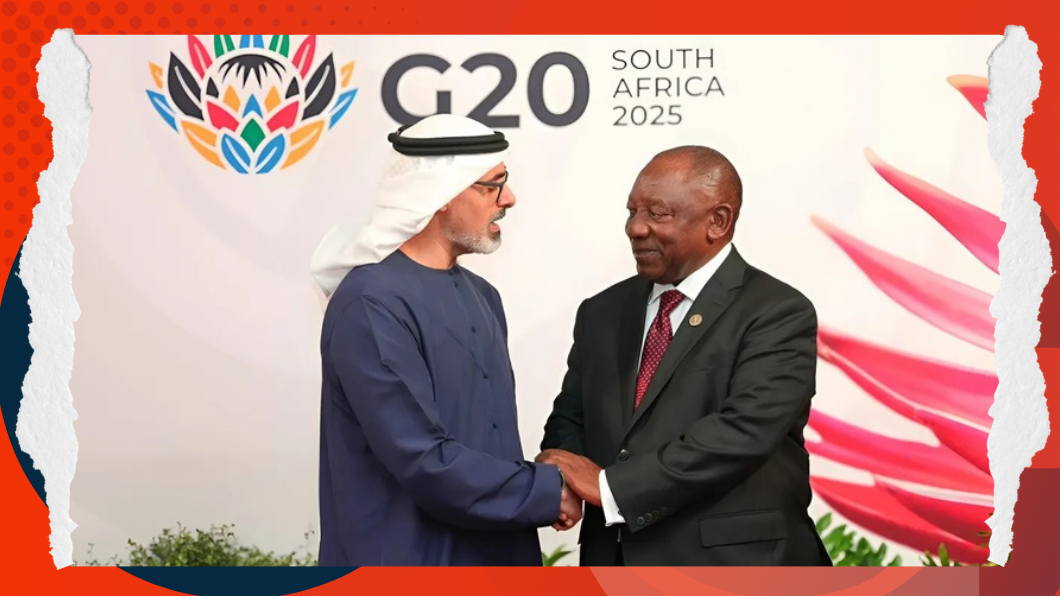
The United Arab Emirates has announced a $1 billion investment commitment to transform Africa’s artificial intelligence infrastructure during the G20 Leaders’ Summit in Johannesburg. The “AI for Development Initiative” targets critical sectors including education, healthcare, and climate adaptation across the continent.

Crown Prince Sheikh Khaled bin Mohamed bin Zayed Al Nahyan delivered the announcement at Africa’s first-ever G20 summit, hosted by South African President Cyril Ramaphosa. The initiative will be managed by Abu Dhabi Exports Office (ADEX) working alongside the UAE Foreign Aid Agency.
Africa’s Critical AI Infrastructure Gap
The continent currently holds less than 1% of global data center capacity despite exploding demand for digital services. The Africa Data Centres Association estimates the region needs an additional 1,200 megawatts of data center capacity by 2030 to meet growing requirements.
Major tech companies are already racing to fill this gap. Amazon Web Services committed $1.7 billion through 2029, while Microsoft pledged $296 million for South Africa’s AI infrastructure by 2027. Google launched four new subsea cable connectivity hubs to strengthen digital corridors across the region.
The timing proves critical as Africa’s youth population is expected to double to over 830 million by 2050. This demographic boom creates both massive opportunity and urgent need for AI adoption across the continent.
UAE Minister Highlights Strategic Vision
“We consider AI not just as a future industry but a cornerstone of humanity’s future,” said UAE Minister of State Saeed Bin Mubarak Al Hajeri. “My country is actively accelerating innovation to enhance productivity and drive significant advancements in the global economy.”
The minister emphasized the UAE’s commitment to developing responsible and inclusive AI technologies that benefit everyone globally. The announcement underscores Abu Dhabi’s growing role as an AI technology exporter beyond its domestic market.
UAE-Africa Trade Relationship Reaches New Heights
The investment builds on already strong economic ties between the UAE and Africa. Bilateral trade hit approximately $107 billion in 2024, representing a 28% increase from the previous year. Total UAE investments in Africa exceeded $118 billion between 2020 and 2024, establishing the Emirates as one of the continent’s biggest investors.
Abu Dhabi is simultaneously scaling its domestic AI capabilities. The UAE now ranks second worldwide with more than 188,000 advanced AI chips and approximately 6,400MW of compute capacity, according to TRG Datacentres Global AI Capability report.
Infrastructure Challenges Drive Partnership Strategy
Despite Africa’s AI ambitions, significant infrastructure gaps persist. The International Energy Agency’s Africa Energy Outlook 2024 estimates about 600 million people still lack electricity access across the continent. Mobile internet remains among the world’s most expensive relative to income.
“There is strong policy ambition and increasing investment, yet the scale and pace of infrastructure still need to expand to meet national AI goals,” said Moussa Beidas of PwC Middle East.
Industry experts identify talent shortages, weak data governance frameworks, and limited capacity to maintain AI models as primary obstacles. However, strategies like edge computing and hybrid-cloud models can ensure AI systems function effectively even with unstable electricity and connectivity.
Investment Could Accelerate Continental AI Adoption
McKinsey research shows Africa’s AI infrastructure remains in early stages. Total installed data center capacity across five leading markets. Egypt, Kenya, Morocco, Nigeria, and South Africa stays below 500 megawatts. This foundation, while small compared to developed regions, provides crucial groundwork for future expansion.
“The funding acts as a powerful accelerent for AI adoption, moving African projects from pilot to operational scale,” said Sid Bhatia, area vice president for Middle East, Turkey and Africa at Dataiku.
The UAE’s investment could deliver substantial gains across logistics, energy, finance, and public services sectors. Jessica Constantinidis of ServiceNow noted the investment “gives Africa the foundational layer it has been missing to operationalize AI at scale.”
Geopolitical Implications of Gulf AI Strategy
The investment reflects the UAE’s strategy to position itself as a global AI hub while navigating complex geopolitical relationships. Rachel Ziemba of Ziemba Insights emphasized the UAE’s long-term commitment to building AI infrastructure both domestically and internationally.
“Gulf countries like the UAE are investing at home, in key global markets like the US, and also in emerging markets,” said Robert Mogielnicki of Arab Gulf States Institute in Washington DC. “They hope these investments will pay off big on financial and strategic fronts.”
The initiative also strengthens existing UAE digital partnerships across Africa. Abu Dhabi-based AI company Presight has signed government agreements for digital infrastructure and smart services with Burkina Faso, Côte d’Ivoire, Senegal, and Uganda.
Africa’s AI infrastructure stands “at an inflection point,” according to PwC’s Beidas. With proper execution and sustained investment, the continent could realize its ambitious AI goals through strategic partnerships like the UAE’s billion-dollar commitment.
The G20 summit, held for the first time on African soil, addressed inclusive economic growth, just energy transitions, and accelerating sustainable development goals globally. The UAE’s AI investment announcement positions Abu Dhabi as a key partner in Africa’s digital transformation journey.