
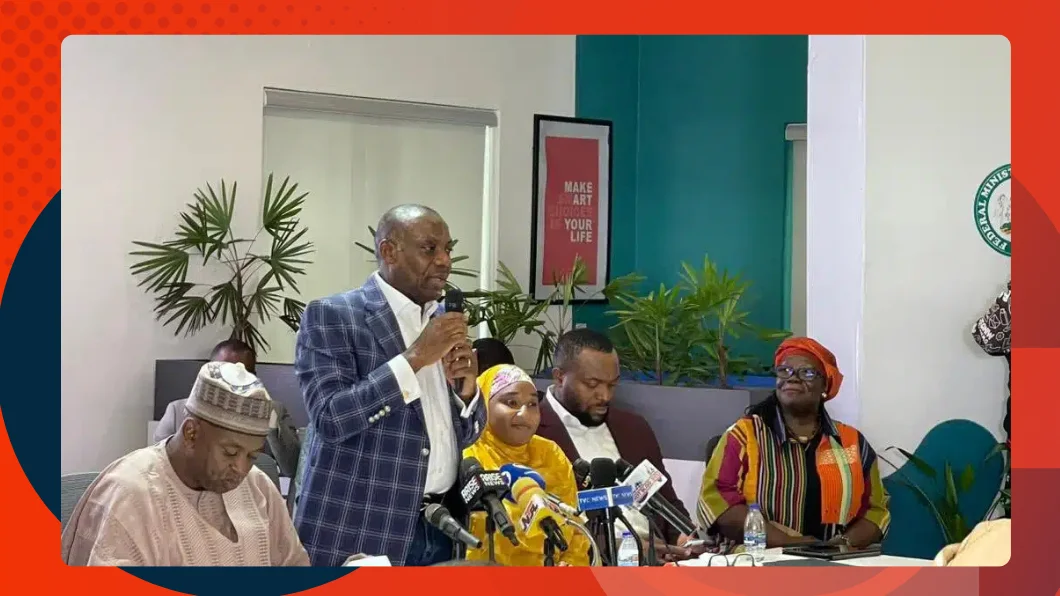
On Sunday, 29 March 2026, the Federal Ministry of Education did something that Nigerian timelines are still processing. At the UNDP Innovation Hub on Alfred Rewane Road in Lagos, forty-five student-founders were handed cheques worth ₦50 million each under the Student Venture Capital Grant (S-VCG) programme. Total disbursement: ₦2,250,000,000. In a single afternoon. Equity-free. No repayment clause.

The photographs tell the story better than any press release. One winner holds a cheque made out to BickQR, dated 29/03/2026, throwing a casual peace sign in front of a backdrop reading “Built by Students. Backed by Nigerian Government. World-Bound.” Another, the founder of HerSync, a women-focused technology platform, stands beaming beside a senior official, her ₦50 million cheque held at chest height, her energy the kind that does not perform for cameras. Oteyola Dunsin of SmartCBT announced on X that his venture building computer-based exam infrastructure for Nigerian secondary schools was selected from over 30,000 applicants, a 0.13% conversion rate that most global accelerators would be proud to claim. Dr. Tunji Alausa posted about the ceremony with pride that felt earned, noting that eight winners came from the University of Lagos alone.
This is a significant moment. It is also a moment that deserves to be examined properly.
Inside The Programme
The S-VCG launched in December 2025 as a flagship initiative under President Bola Ahmed Tinubu’s Renewed Hope Agenda, administered by the Federal Ministry of Education in partnership with the Bank of Industry. It received 30,639 applications from students across 404 tertiary institutions nationwide. From that pool, 65 were shortlisted as finalists and brought to Lagos for a four-day intensive bootcamp running from Thursday 26 March through Sunday 29 March 2026. Pitch sessions, venture development workshops, live evaluations, and investor-style feedback panels preceded the final cut. Forty-five emerged as winners.
The selection process ran in four stages. Stage One deployed AI-enabled screening for eligibility and alignment, a practical response to reviewing 30,000 applications with any consistency. Stage Two introduced independent human validation and a multi-sectoral evaluation panel drawn from government, industry, academia, and the investment community, with assessment criteria covering scalability, feasibility, founder capability, and impact potential. Stage Three was the live bootcamp itself. Stage Four was the awards ceremony, broadcast on Channels TV and Arise TV.
Partners on record include the Bank of Industry, The Afara Initiative, UNDP represented by Elsie Attafuah, and the Tertiary Education Trust Fund. The winners span federal, state, and private universities, with the majority drawn from public institutions. The ventures range from CBT infrastructure to payments to HerSync, a women-focused technology platform, confirming that the cohort’s range of ideas matches its range of founders.
The equity-free structure deserves particular mention. The programme took no equity from pre-revenue student founders, which is more founder-protective than many comparable programmes globally, and the single most important design decision the Ministry got right.
Nigeria Stacked Against The World
Nigeria is not the first government to back student founders at scale, but the S-VCG sits in genuinely interesting company when placed alongside comparable programmes.
The United States runs the Small Business Innovation Research programme, which channels federal agency funding into early-stage ventures including student-led ones. Individual Phase One grants range from $50,000 to $275,000, roughly in the same territory as the S-VCG grant at current exchange rates. The SBIR feeds into a Phase Two structure that can unlock up to $1.75 million, with detailed reporting requirements attached throughout. The relationship between the federal government and the funded venture does not end at the cheque.
The United Kingdom’s Innovate UK Young Innovators programme provides grants of up to £50,000 to individual founders aged 18 to 30, with structured business support running alongside the funding. It sits within UK Research and Innovation, a body that coordinates across government departments, giving funded founders access to state infrastructure beyond the immediate grant.
India’s Startup India Seed Fund Scheme, launched in 2021, allocated the equivalent of roughly $113 million to provide seed funding per startup through a network of incubators. The incubator-mediated model means funding arrives with institutional support already attached. The scheme operates in direct coordination with India’s dedicated startup policy architecture, not in parallel to it.
China’s Mass Entrepreneurship and Mass Innovation initiative, launched in 2015, channelled state funding through university incubators and national science parks with explicit linkage between student venture funding and national technology development goals. The coordination between education institutions, technology ministries, and funding bodies was structural from the outset.
Where the S-VCG stands out against all of these is the openness and rigour of its application process. 30,639 applicants from 404 institutions is a reach figure that most of those programmes did not achieve in their first editions. What the more established programmes have that S-VCG does not yet publicly articulate is a defined post-grant infrastructure that makes the funding the beginning of a relationship rather than the conclusion of one.
The Minister Who Should Have Been In This Room
There is a name absent from everything announced last weekend, and it is the most conspicuous absence in the story.
Dr. Bosun Tijani, Nigeria’s Minister of Communications, Innovation and Digital Economy, does not appear anywhere in the official S-VCG communication. His ministry is not listed among the programme partners. His name does not feature in any of the ceremony coverage. And for anyone who knows his biography, that absence is genuinely striking, because the day before the S-VCG ceremony, Tijani was making announcements of his own.
On Saturday, 28 March, the Ministry of Communications, Innovation and Digital Economy announced the Expression of Interest for the National Digital Economy Research Clusters, a ₦12 billion research funding scheme designed, in Tijani’s own words, to place ideas, evidence, and research at the centre of Nigeria’s digital transformation. The programme is funded under Project BRIDGE, the Ministry’s initiative to deploy 90,000km of fibre optic backbone infrastructure across Nigeria. It will establish six national research clusters covering connectivity and access, digital public infrastructure and government, digital skills and human capital, digital economy jobs and livelihoods, trust and online safety, and artificial intelligence and emerging technologies. Up to 36 distinguished professors from 36 Nigerian universities will lead the clusters alongside international academic partners, with over 200 researchers including postdoctoral fellows and PhD candidates generating policy-relevant research to guide Nigeria’s digital economy. Tijani described it as one of the most meaningful programmes of his ministerial tenure precisely because it plants seeds that outlast any single administration.
That is a serious announcement. It is the kind of policy architecture that would sit naturally alongside a programme like the S-VCG, not in competition with it but in sequence. Fund the student founders on Sunday. Fund the research clusters that will generate the policy environment those founders operate in. The two programmes, run by two different ministries on consecutive days, are addressing different layers of the same ecosystem without any publicly visible coordination between them.
Tijani co-founded CcHUB in 2010, building it from a co-working space in Yaba into the leading pan-African technology and innovation centre with presence in Nigeria, Kenya, Rwanda and Namibia. Before there was a formal government structure for backing Nigerian student founders, he was the man who built the institution that did it privately. Since entering government, he has convened over 120 AI researchers to co-create Nigeria’s National AI Strategy, established the Nigeria AI Collective as a community of practice for safe and ethical AI deployment, secured Gates Foundation interest in funding Nigerian AI researchers, and sits on the inaugural Africa AI Council established by the Smart Africa Board in November 2025. He was named to the TIME100 AI 2025 list alongside Sam Altman and Jensen Huang.
This is the minister who spent over a decade incubating exactly the kind of student and early-stage founders that the S-VCG has now funded. His ministry made a landmark ₦12 billion research announcement the day before. And yet as of the time of writing, there is no post on his timeline about the S-VCG, no congratulations to the 45 winners, no statement connecting the Education Ministry’s programme to the digital economy mandate his own ministry holds.
That silence is not necessarily a sign of conflict. Nigerian government inter-ministerial coordination is structurally difficult, and two ministers pursuing parallel but complementary agendas without speaking publicly about each other is not unusual. But it is a missed opportunity, and in a week where both ministries made genuinely significant announcements about Nigeria’s technology future on consecutive days, the absence of any visible thread connecting them is the question the ecosystem should be asking loudly.
What This Administration Got Right
The Student Venture Capital Grant is one of the most consequential things the Tinubu administration has done for young Nigerians since taking office.
One thing deserves specific credit before anything else: the government did not take equity. At the precise moment when these founders are most vulnerable and least positioned to negotiate, the state handed them capital with no strings attached and no ownership stake claimed. That is not standard practice globally, and it matters more than any ceremony backdrop or ministerial speech.
The cultural signal this sends to a secondary school student watching Channels TV on a Sunday evening is not small. A generation told, repeatedly and by circumstance, that this country does not back people who build things here, watched forty-five of their peers collect ₦50 million each from a government stage last weekend. That image does not expire quickly.
One edition does not make an institution. But the first edition was the right thing to do, and for a Nigerian government programme in 2026, that is not a small thing to be able to say.