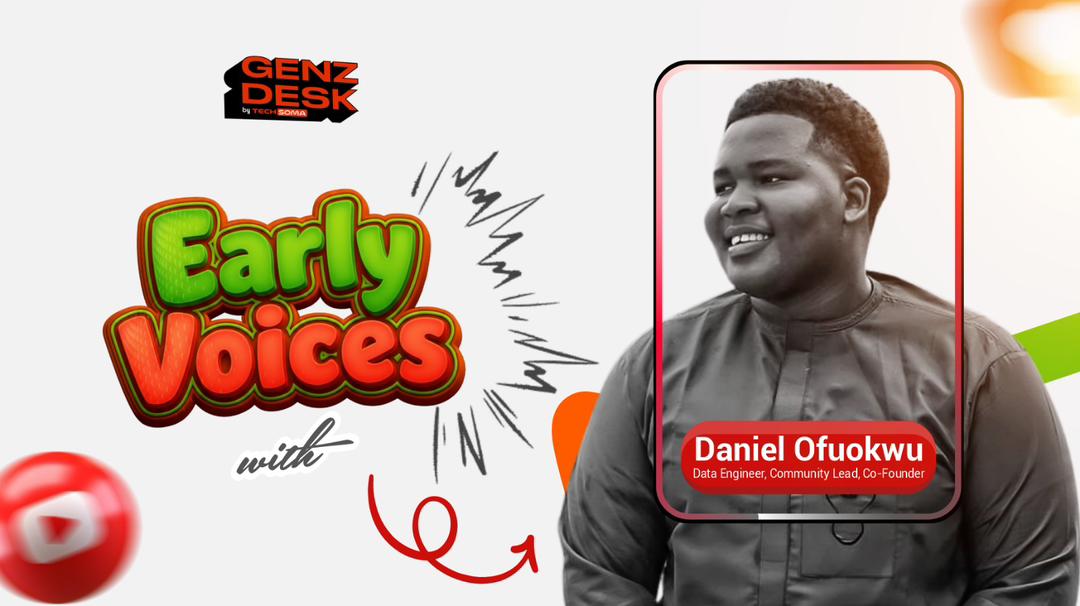
Daniel Ofuokwu will tell you he’s just a final year student. Spend five minutes with him and that description starts to feel like a deliberate understatement.

At his university, Daniel is finishing a degree in Electronics and Computer Engineering. But his day-to-day looks nothing like a typical final year. He’s a practicing data engineer, the founder of DataZens, a growing community for young data enthusiasts across Africa, and the co-founder of Food Lab, a food delivery platform built from scratch for his campus. He’s running all three simultaneously. And he’s not done yet.
The Data Journey That Began In a Closet
Daniel didn’t discover data through a course or a career fair. His brother introduced him to it, and from that point, something clicked.
“I say love because I love it,” he says. “It has been the most important thing in my life for a while.”
For the first stretch of his journey, he kept it quiet. Secret, almost. Learning alone, building alone, figuring things out in what he describes as his own “closet.” It wasn’t until later that he understood what that isolation was costing him.
“My journey was a little bit secretive at first — like the secret gig you have in your closet. But networking and community is always going to be important. Because sometimes when you’re running mad in your closet, somebody already has the cure to your madness. But if you don’t know, you just keep running mad.”
He got his IBM Data Engineering Professional Certificate on Coursera — a programme broken into 14 certificates under one major qualification — and built his skills methodically, on his own terms, outside his degree. Today he works as a data engineer. Not after graduation. Right now, while still in school.
The Community He Built Because The Room Didn’t Exist
DataZens started because Daniel wanted to create the space he wished had existed when he was starting out. A community for young people curious about data — analysis, engineering, management — who wanted to learn, grow, and find opportunities together.
What he didn’t expect was how hard it would be.
“I thought community was a place where we come together and everyone will be bringing ideas and flowing,” he says. “But it turns out people just join and become ghosts.”
The low point came during a webinar in DataZens’ early days, there were a hundred members and only four showed up.
“At that point I wanted to give up. But then I thought about it. What about the four people that actually took their time to come? What’s going to happen to them if we end it?”
That question became his anchor. He didn’t shut it down. He kept going for the four. And slowly, the four became more.
“It’s not about how many. It’s about how well you impact the few you have. It doesn’t matter how many people reply to messages or do the tasks — if there are little people doing it, I’m doing something right.”
Now, three years in, DataZens has found its rhythm. People are driving each other. Members are showing up with ideas, accountability, and energy. “We can see the growth. We can see the drive in everybody’s eyes.”
The Startup That Started With Hunger
Food Lab might be the most Daniel story Daniel has.
He and his friends moved off campus. There was nowhere to eat nearby. And when they looked back at campus, they realised something obvious that nobody had acted on: there was no food delivery system. Not Chowdeck. Not any local alternative. Nothing.
“We got tired of eating bread. So we decided to do something about it.”
Food Lab is now a food delivery network connecting customers, restaurants, and riders within their campus ecosystem. Simple concept. Real infrastructure. Real customers. Built because a problem existed and Daniel decided he was the person to solve it.
But building it cracked open a harder education, one about the Nigerian tech system.
“It opened my eyes to see how heavily damaged the Nigerian tech system is,” he says. A hosting platform they relied on nearly killed the business. Terrible customer support. No accountability. Services going down with no resolution. “You go to their office and realise these people don’t actually know what they are doing. They’re just there for vibes.”
His frustration isn’t just personal. It’s a systems argument. “People are losing touch of growth. We’re accepting the arrant nonsense as the way it is. And I can’t stand for that.”
How To Start Data Engineering in 2026, From Scratch
Ask Daniel where to begin and he doesn’t hesitate.
“The first thing I’ll do is go on Coursera and get my IBM Data Engineering Professional Certificate, like I did before. It broke everything into 14 different certificates and took me on a journey through the different parts of data.”
After that: community, projects, and showing your work.
“Join a community. Network. Talk to more people. And handle projects. Projects are very, very important. You can go on YouTube, get a random project somebody has done before, and do it yourself. Because watching somebody do something does not mean you can do it. You can follow somebody step by step and still have issues.”
And if you’re scared to put yourself out there?
“Nobody will beat you. You are a data analyst, a data engineer, you’re designing something — put it out there. You have four, five viewers? The four, five viewers are going to beat you? Nobody anywhere will beat you. What’s the worst that could happen?”
One Thing For Every Student Trying To Balance School And Tech
Daniel’s final word isn’t gentle. It’s direct in the way only someone who’s actually done it can be.
“No matter how much you’re concerned about now, you need to think about your future. We’re not doing tech because of fun. We’re doing tech because we want the future. And if you’re serious about your future, you’re going to make plans to make it solid.”
That means cutting what doesn’t serve the goal. School politics. Unnecessary commitments. Things that feel urgent but aren’t building anything.
“Stop fooling. Fooling is a lifestyle sometimes. But you need to stop doing things that are unnecessary. That’s all.”
Daniel Ofuokwu is a data engineer, founder of DataZens community, and co-founder of Food Lab. Follow him on X: @iambig_dan
Early Voices is a GenZ Desk series spotlighting young people on their tech journeys — honest, specific, and exactly as they happened. Want to share your story? Link in our instagram bio.