

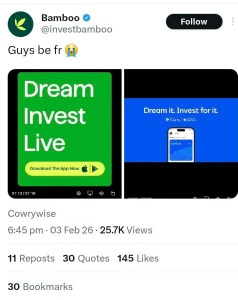
The Nigerian fintech space just witnessed an awkward moment. Bamboo, the investment platform, posted a tweet calling out Cowrywise for what appears to be remarkably similar advertising. The evidence sits side by side in their social media post: Bamboo’s green-backed “Dream Invest Live” campaign next to Cowrywise’s blue-themed “Dream it. Invest for it.” The resemblance is hard to miss.

This isn’t about hurt feelings or creative theft. It reveals something uncomfortable about how Nigerian startups operate: when the pressure is on, originality is often the first casualty. In a sector where everyone is chasing the same customers with nearly identical products, the easiest path is simply watching what your competitor does and doing it slightly differently.
When “Inspiration” Is Just Laziness in Disguise
Let’s be honest about what happened here. Cowrywise didn’t accidentally stumble upon a similar tagline. They saw Bamboo’s campaign, recognized it was working, and decided to run their own version. The structure is identical: Dream + Invest + aspirational verb. Even the visual layout mirrors Bamboo’s approach: bold text, app download prompt, and mobile phone imagery.
This goes beyond market convergence or independent thinking. It’s the corporate equivalent of copying someone’s homework and changing a few words to avoid detection. The “Guys be fr 😭” caption from Bamboo is an example exhaustion at operating in an ecosystem where imitation is treated as strategy.
The Venture Capital Assembly Line
Here’s the uncomfortable truth: venture capital has created an environment where startups are incentivized to copy rather than innovate. When investors fund multiple companies in the same space they’re essentially betting that execution matters more than originality.
Bamboo and Cowrywise both compete for investor attention, user downloads, and market dominance. They’re backed by similar investor profiles, target the same demographic of young, tech-savvy Nigerians, and offer functionally identical products. With so little room for product differentiation, marketing becomes the battlefield. Yet even here, the instinct is to mimic rather than distinguish.
This is what happens when startups optimize for growth metrics instead of building something people actually remember. Cowrywise likely ran the numbers and decided that a proven campaign structure was less risky than attempting something original. But what they gained in safety, they sacrificed in respect.
What Actually Needs to Change
Nigerian fintechs need to stop treating originality as optional. The ecosystem is maturing, and the tolerance for lazy imitation should be declining with it. Cowrywise could have responded to Bamboo’s campaign by creating something that acknowledged the same emotional territory while approaching it from a completely different angle.
Instead, they chose the path of least resistance. And Bamboo, rightfully, called them out for it. The question now is whether this public shaming will prompt broader reflection within the industry, or whether everyone will shrug, move on, and continue the cycle of copying until the next company gets caught.
The Nigerian fintech space has real potential, but that potential won’t be realized by companies that can’t be bothered to develop their own voice. Competition should sharpen you, not turn you into a mirror of everyone else.