Africa has always produced powerful stories. Nollywood films fill screens across continents. African YouTube creators rack up tens of millions of views. Afrobeats soundtracks global playlists. The creativity has never been in question. What has held many creators across the continent back is access to tools that can scale their creativity faster and farther.
Google just took a direct step to change that.
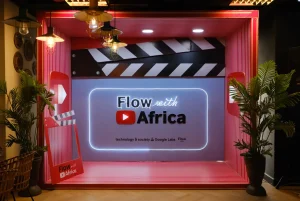
Google Brought 20 African Creators to Lagos for a Hands-On AI Workshop
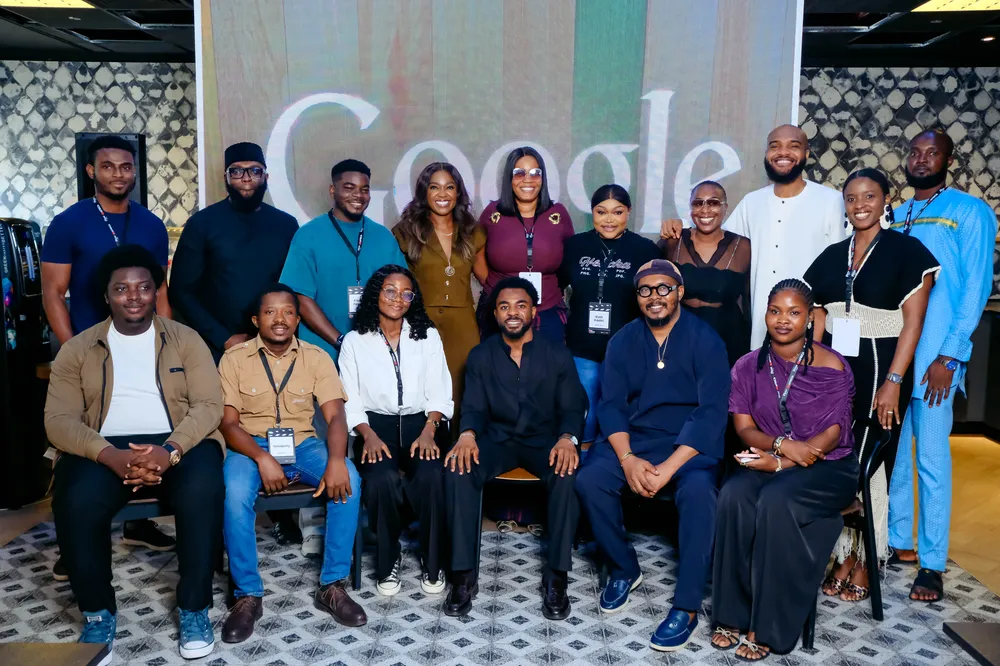
Earlier this year, Google invited 20 of Africa’s top filmmakers and YouTube creators to its office in Lagos, Nigeria, for an intensive workshop on generative AI. The goal was simple and practical. Google wanted these creators to walk away knowing exactly how to use AI tools inside their real production workflows, not just understand AI in theory.
The workshop brought together names like Omoni Oboli, Biodun Stephen, Ruth Kadiri, Fisayo Fosudo, and Tayo Aina, among others. Google partnered with award-winning Nigerian filmmaker and creative technologist Malik Afegbua to lead the sessions. Afegbua, who is globally recognised for his pioneering AI-driven creative work, shaped the curriculum to match the specific challenges and opportunities that African creators face.
What the Creators Actually Got Access To
Google gave each workshop participant three months of unlimited access to Flow, its AI filmmaking tool built on Veo 3.1, the company’s most advanced video generation model. Alongside that, participants received a subscription to Google One AI Premium. These were not demo accounts or limited trials. Creators got full access they could use immediately on live projects.

During the sessions, participants worked directly with an expert trainer across hands-on exercises using Flow and Gemini, Google’s AI assistant. After the workshop, Google connected the group to a global Discord community of Flow power users and leading AI filmmakers. That ongoing access to mentorship and technical support extends the value of the programme well beyond the workshop days.
Five Practical AI Techniques the Workshop Taught
The workshop focused on techniques that creators can apply right away. These were not abstract concepts. They were specific methods tied to specific tools.
Creators learned to use Gemini as a script supervisor. Gemini’s deep research feature can pull hyper-specific cultural details, such as Nigerian social etiquette from the 1960s or the precise weave patterns of traditional Aso-Oke fabric. Feeding those cultural markers into AI generation tools produces content that is more authentic and culturally accurate. Creators also learned to upload their research directly to NotebookLM to extract key insights and verify facts before production begins.
On the video side, participants learned how to direct AI-generated footage with precision using Flow. The technique involves setting a starting keyframe and an ending keyframe to guide a character’s performance arc through a scene. That approach gives creators deliberate control over narrative rather than accepting whatever the AI produces at random.
For maintaining visual consistency across a full film or series, the workshop introduced character consistency tools. A creator generates a single reference image of the lead character in a neutral studio setting, then applies that reference across every subsequent scene in Flow. The character’s appearance stays identical across different locations and lighting conditions throughout the entire narrative.
The workshop also reinforced a core principle about the relationship between AI and human creativity. AI handles generation. Humans make the final artistic decisions. Creators learned to use local editing features to manually fix small details in AI-generated footage, refining results until they match the creative vision precisely.
Finally, participants learned how to use YouTube’s automatic dubbing feature to reach audiences in other languages. YouTube has now expanded this tool to 27 languages. That expansion directly addresses one of the biggest barriers African creators face when trying to reach global audiences beyond English-speaking markets.
What This Means for African Storytelling Going Forward
African storytelling has never lacked imagination or cultural depth. The stories are extraordinary. The talent is real. What AI tools like Flow and Gemini do is remove friction between the idea and the finished product. A filmmaker who previously needed a larger crew or a bigger budget to realise a complex scene can now produce that scene with a well-directed prompt and a refined keyframe. That changes what is possible for independent creators across the continent.
Google’s initiative also sends a clear signal to the tech industry. Africa’s creative sector is not a charity case waiting for investment. It is a fast-growing economic engine that global companies want to be part of. The $30 billion projection for Sub-Saharan Africa’s content economy by 2032 is not wishful thinking. It is the direction the data already points.
The creators who walked out of that Lagos workshop left with more than new skills. They left with tools, community, and three months to produce work that proves what African storytelling looks like when it has the same technological access as anyone else in the world.