
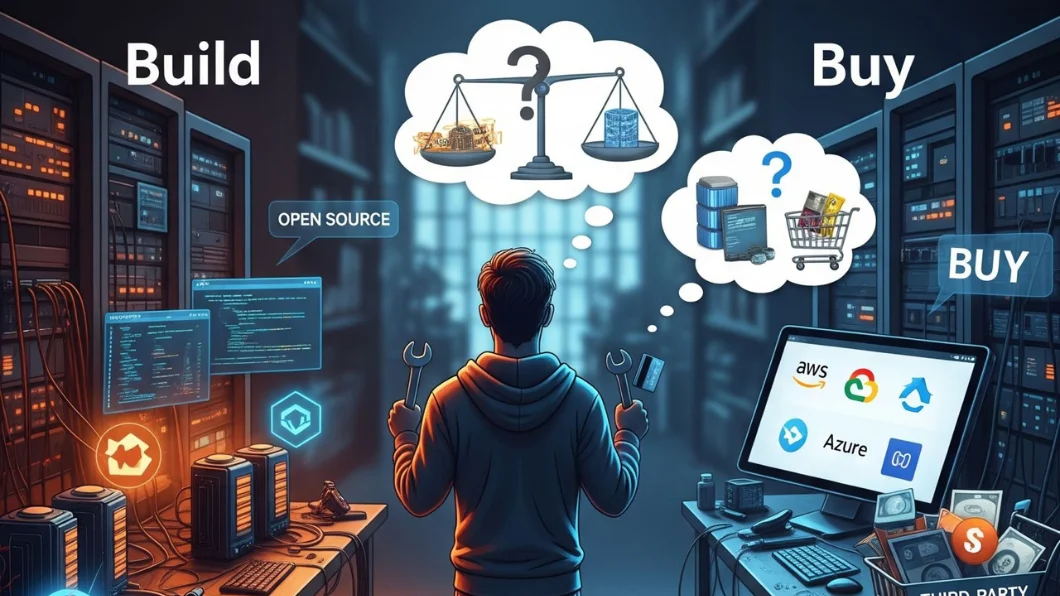

Starting a tech company means making hundreds of infrastructure decisions before you write your first line of business logic. Do you self-host or go cloud-native? Build custom solutions or integrate third-party services? Choose enterprise platforms or piece together open source tools?
As a founder-engineer building our software platform from scratch, I’ve made these decisions dozens of times over the past year. Some worked out brilliantly. Others cost us time, money, or both. Here’s what I’ve learned about the build-vs-buy philosophy when every dollar and engineering hour counts.
The Self-Hosting Decision
Our first major choice was hosting. AWS, Google Cloud, and Azure all offer compelling managed services that promise to handle infrastructure complexity. But for an early-stage startup, those managed services come with costs that add up quickly.
We chose self-hosting for most of our infrastructure. Not because we love managing servers nobody does, but because the economics made sense for our situation. When you’re building software platforms that integrate with multiple external services and handle growing datasets, cloud costs can spiral from hundreds to thousands of dollars monthly before you have the revenue to justify it.
Self-hosting isn’t just about cost savings, though. It’s about control. When your platform depends on specific performance characteristics or data residency requirements, having direct control over your infrastructure becomes a competitive advantage. We can optimize our servers for our exact workloads rather than accepting the compromises of shared cloud resources.
The trade-off is operational complexity. Self-hosting means we handle security updates, backup strategies, and monitoring ourselves. But for a technical team willing to invest in proper automation, this complexity is manageable and often less than debugging obscure cloud service limitations.
Open Source as Strategic Foundation
We’ve built our stack primarily on open source tools, and this choice has paid dividends beyond just licensing costs. Open source gives us transparency into how our tools work, the ability to customize them for our needs, and protection against vendor lock-in.
Take our workflow automation. Instead of subscribing to Zapier or Microsoft Power Automate, we deployed n8n. It handles our client onboarding workflows, data processing pipelines, and integration orchestration. The initial setup took more engineering time than buying a SaaS solution, but we now have workflow capabilities that would cost hundreds of dollars monthly elsewhere, plus complete control over how they operate.
For business process management, we chose Zeebe with BPMN instead of enterprise workflow platforms. This gives us sophisticated process orchestration without the per-user licensing fees that would make serving small clients unprofitable. When your business model depends on offering affordable solutions, these licensing savings directly impact your ability to serve your target market.
We’re using Novu for notifications instead of building from scratch. Again, the trade-off is setup complexity for cost savings and customization flexibility. When you’re sending thousands of notifications across email, SMS, and in-app channels, those per-message costs add up quickly.
When Third-Party Makes Sense
Not everything should be built or self-hosted. We use third-party services for capabilities that are either too complex to build reliably or where the cost-benefit clearly favors buying.
Payment processing is the obvious example. Building your own payment system would be engineering malpractice for most startups. We integrate with Stripe because payments require regulatory compliance, fraud detection, and global banking relationships that would take years to build independently.
We also integrate with external AI services rather than building our own models. While we could theoretically train large language models, the computational costs and expertise required make it impractical for our stage. We focus our limited resources on building the infrastructure and user experience around these integrations rather than the underlying AI capabilities themselves.
For web scraping and content extraction, we use crawl4ai instead of building our own solution. Web scraping involves constantly adapting to anti-bot measures, handling different content formats, and managing request rates across thousands of websites. The engineering effort to build this reliably would exceed the value it provides to our core business.
The Hidden Costs and Business Models
Every build-vs-buy decision involves hidden costs that aren’t obvious upfront. But there’s also a business model consideration: sometimes building custom solutions for clients is more expensive to deliver but commands higher margins.
Building for Clients vs. Building for Yourself
When clients need custom applications built specifically for their business, this represents a different type of “build” decision. Building bespoke software requires significant engineering investment upfront, but it often yields better profit margins than selling standardized SaaS subscriptions. The complexity and customization justify premium pricing that generic solutions can’t command.
The trade-off is clear: custom builds take longer to deliver and require more specialized expertise, but they create stickier client relationships and higher per-client revenue. Clients with unique business requirements will pay substantially more than someone buying an off-the-shelf solution.
Infrastructure Build-vs-Buy Costs
For internal infrastructure, building means ongoing maintenance, security updates, and feature development. Buying means subscription costs, integration complexity, and dependency risks.
The maintenance burden of self-hosted tools is real. Our MongoDB clusters need monitoring, our Redis instances need performance tuning, and our application servers need security patches. This operational work doesn’t directly generate revenue, but it’s essential for reliability.
But buying has hidden costs too. SaaS subscription costs compound quickly as you scale. What starts as $50/month for a tool can become $500/month as your usage grows. Multiply these across dozens of services, and you can find yourself spending thousands monthly on tools before you have significant revenue.
Sometimes the engineering effort to integrate a “simple” SaaS tool ends up exceeding the effort to build a basic version yourself.
Decision Framework That Works
Over time, I’ve developed a framework for these decisions that considers both immediate and long-term implications:
Build when:
- The functionality is core to your competitive advantage
- Third-party options are significantly more expensive than your engineering time
- You need specific customization that isn’t available elsewhere
- The technology is stable and well-understood (databases, web servers, basic CRUD operations)
Buy when:
- The functionality requires specialized expertise you don’t have
- Regulatory or compliance requirements make building risky
- The third-party solution is significantly better than what you could build
- Your engineering time is better spent on core business logic
Self-host when:
- You have the operational expertise to manage it reliably
- Cost savings justify the operational overhead
- You need specific performance or security characteristics
- The technology is mature and stable
Use managed services when:
- You’re optimizing for speed of development over cost
- The operational complexity exceeds your team’s current capabilities
- Reliability requirements exceed what you can achieve with current resources
Real-World Trade-offs
These decisions aren’t made in isolation. They affect each other and your overall system architecture. Choosing to self-host means you need monitoring, backup, and deployment infrastructure. Choosing open source means you need processes for evaluating, updating, and securing dependencies.
Our choice to use primarily open source tools on self-hosted infrastructure means we have lower ongoing costs but higher upfront engineering investment. This makes sense for our business model and technical capabilities, but it wouldn’t be right for every startup.
A team optimizing for time-to-market might choose the opposite approach: managed cloud services and premium SaaS tools to eliminate operational overhead. The monthly costs would be higher, but they’d get to market faster and could focus entirely on product development.
Looking Forward
As we scale, some of our build-vs-buy decisions will change. Tools that made sense to self-host at our current scale might become worthwhile to buy as managed services when operational complexity outweighs cost savings.
The key insight is that these decisions aren’t permanent. You can start with open source and self-hosting to minimize costs, then migrate to managed services when the economics change. Or you can start with SaaS tools for speed, then build internal solutions when you have the resources and specific requirements.
What matters is making conscious decisions based on your current constraints and capabilities, not following someone else’s playbook. The right choice for a well-funded startup with a large engineering team isn’t the same as the right choice for a bootstrap startup with two technical founders.
The Bottom Line
Build-vs-buy decisions shape your startup’s cost structure, operational complexity, and competitive positioning. There’s no universally right answer, but there are frameworks for making better decisions.
For us, the combination of self-hosting and open source tools has enabled us to build sophisticated infrastructure on a startup budget while maintaining control over our technical destiny. The trade-off is operational complexity, but it’s complexity we can manage and that gets easier over time.
The most expensive mistake is not making these decisions consciously. Whether you choose to build or buy, make sure you understand the full implications and have a plan for evolving your choices as your business grows.
Every engineering hour and dollar matters when you’re building something from scratch. Spend them wisely.