
The Announcement That Woke the Internet
It happened in the early hours of March 25, 2026. At 1:36 AM, Nikita Bier, a product executive at X (formerly Twitter), posted what appeared to be a routine platform policy update. The announcement was framed as a revenue-sharing reform, a tweak to better “reward the content we want on X.” The language was measured. The implications were anything but.

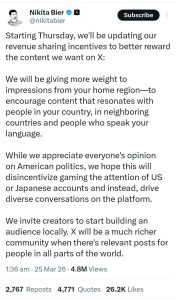
Bier’s post stated that X would begin giving more weight to impressions coming from a creator’s “home region,” meaning impressions from your country, neighbouring countries, and people who share your language. On the surface, it sounded like a localisation push, a way to celebrate regional content and make the platform feel more culturally relevant around the world. But one paragraph buried in the announcement revealed the real target: “While we appreciate everyone’s opinion on American politics, we hope this will disincentivize gaming the attention of US or Japanese accounts and instead, drive diverse conversations on the platform.”
In plain English: if you are a creator outside the United States or Japan, and your content is performing well with American or Japanese audiences, that performance would now count for less in determining how much money you earn.
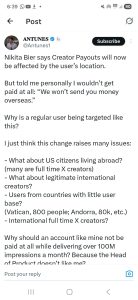
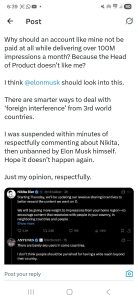
For creators in Nigeria, Ghana, Kenya, India, Brazil, the Philippines, and virtually every developing market where X has a growing, highly active user base, this was a direct threat to their income.
He Said Nigeria. By Name.
The announcement alone would have generated debate. What turned it into an international incident was what Bier said next. Replying to a comment at 1:47 AM, he chose a specific example to illustrate the problem he was trying to solve: “Precisely. Fewer Ivanka Trump Fan accounts based in Nigeria and more Nigerians sharing their thoughts about Nigeria.”
Not Eastern Europe, where coordinated engagement operations are well-documented. Not domestic US accounts, which run political content farms around the clock with complete impunity. Not India, Southeast Asia, or Latin America, where the same behaviour patterns exist at scale. Nigeria. Named. In a public reply with 310,000 people watching, from an executive of the platform those people depend on for their income.
That is not a policy clarification. That is a targeting decision communicated in plain sight.
The backlash was immediate and global. A commenter named Eric from DeFi Infra replied within hours: “But there are many Elon Musk accounts from India and other parts of Asia. Why did you bring Nigeria into this?” It was the right question, and Bier did not have a satisfying answer for it. If the behaviour being targeted is platform-wide, the example used to explain it should be platform-wide. It was not.
By 7:03 AM, Elon Musk had seen enough. He posted four words: “We will pause moving forward with this until further consideration.” The policy was halted before it could go live.
What X Was Actually Trying to Solve
Before this becomes a straightforward story of a platform attacking African creators, it is worth giving the underlying concern a fair hearing. Because the problem Bier was trying to address is real, and dismissing it entirely does not serve anyone.
X’s revenue-sharing programme has, since its launch, attracted a category of account built entirely around extraction. These accounts study which content performs well with high-CPM audiences in the United States and Japan, calibrating every post for reach among the most monetisable users on the platform. American political controversy, celebrity drama, culture war flashpoints: the formula is well understood and widely applied. There is no community behind these accounts. There is no consistent viewpoint. There is a content strategy optimised entirely around what X’s algorithm will pay for.
This is not a small-scale phenomenon. It has genuinely degraded the quality of content reaching American and Japanese users, who find their feeds populated with posts about their own domestic politics produced by accounts that have no personal stake in the outcome and no expertise to offer. It frustrates authentic creators who are building real audiences through real work. And it creates a financial sustainability problem for X, which is paying out revenue to accounts whose existence adds nothing to the platform’s cultural or informational value.
Bier was not inventing a problem. He was reaching for a tool to fix one. The question is whether the tool he reached for was the right one.
Why the Policy Was the Wrong Answer
The flaw in the proposed reform is that it treated geography as a proxy for authenticity. It is a poor proxy.
The assumption embedded in the policy is that a creator’s legitimate audience is the one nearest to them: same country, same language, same regional news cycle. That assumption might have made sense for a local newspaper in 1992. It does not hold for a global social platform in 2026, where the most compelling content routinely travels thousands of miles to find exactly the audience it was meant to reach.
Consider the categories of creators who would have been directly punished by this change, without having done anything wrong.
Nigerian journalists covering US-Africa trade relations, dollar-denominated debt policy, or American immigration decisions affecting the diaspora have spent years building audiences among American policymakers, foreign affairs analysts, and diaspora communities who need that coverage. Their US impressions are not incidental. They are the point. The people who can create change around the issues these journalists cover are not all in Lagos.
Indian tech creators, cricket analysts, and political commentators have built some of the most sophisticated English-language commentary communities on the platform. Their audiences span Mumbai, London, Singapore, and San Francisco because the subjects they cover are genuinely international subjects with genuinely international audiences. Telling them their UK and US impressions count for less is not protecting the platform’s integrity. It is penalising competence.
Sports creators across Africa and South Asia made the most structurally airtight argument of all. The English Premier League has a larger viewership in Nigeria than in England. The IPL is a global media event. Formula 1’s fastest-growing audiences are in the Americas and Asia. A creator in Nairobi who has built a Premier League following is serving a Kenyan audience that is deeply, genuinely invested in English football. That some of his followers also happen to live in Manchester is not suspicious. It is the natural consequence of covering a sport that belongs to the world.
Diaspora creators exposed perhaps the most fundamental incoherence in the policy. A second-generation Nigerian-American making content about navigating both cultures does not have a foreign audience. She is the bridge between two audiences that are both hers. A Jamaican-British creator whose following is split between London, New York, and Kingston is not gaming a foreign market. He is a product of all three places. The policy had no answer for these creators because it was not designed with them in mind.
Refugees and displaced journalists described what the policy would have meant for their work specifically. A Syrian reporter covering humanitarian conditions in the north of the country had built his most engaged readership among American NGO workers and foreign policy researchers, not because he targeted them, but because they needed reliable, English-language coverage that their own media was not supplying. His impressions skew American because his subject demands a global audience to matter. Downweighting those impressions would not have made his journalism more authentic. It would have made it less financially viable.
The Elitism Hidden in the Architecture
Beyond the individual cases, the policy had a structural problem that its framing as a localisation push deliberately obscured. X’s advertising rates are not geographically neutral. American users are worth significantly more per impression than users in most African, South Asian, or Latin American markets. This is a function of advertiser demand and purchasing power, not user quality or engagement depth.
What the proposed reform would have done is take that already-unequal structure and codify it as an expression of platform values. By telling creators to build audiences locally and weighting home-region impressions more heavily in revenue calculations, X would have been instructing creators in lower-CPM markets to serve audiences that are, through no fault of their own, less valuable to advertisers, and to accept that diminished earning potential as the natural order of things.
A creator in New York building a US audience earns well under any version of this policy. A creator in Lagos building a Nigerian audience earns less, not because of the quality of their work, not because of the size of their following, but because the economics of digital advertising have determined that their audience is worth less per eyeball. The reform would not have addressed that disparity. It would have locked it in as policy.
This is where the debate stops being about engagement farming and starts being about something more uncomfortable: whether a platform that depends on global participation is willing to build an economy that treats global participation as a problem.
The World Is Global. Sport Is Global. Politics Is Global.
One of the stranger assumptions behind the policy is that interest in American politics is, for most of the world, performative. Something engaged with for revenue rather than a genuine stake. It is worth examining that assumption directly.
When the Federal Reserve adjusts interest rates, the naira, rupee, and cedi respond within hours. When Washington sanctions a government, African businesses lose contracts before the week is out. When US immigration policy shifts, it disrupts diaspora families across three continents. The idea that a Nigerian creator discussing American politics is doing so without genuine investment in the outcome reflects a particular kind of insularity: the assumption that what happens in Washington is really only Washington’s business.
American politics is global news because American decisions have global consequences. A creator in Abuja who writes about US-Africa policy is not farming foreign content. She is covering her own geopolitical reality from a vantage point that most American media does not bother to provide. The same is true of Indian creators writing about Silicon Valley policy, Kenyan creators writing about IMF conditions, or Brazilian creators covering the US relationship with Latin America.
Digital nomadism adds one more complicating layer. Millions of people now live and work outside their country of birth. Nigerian developers building products for American clients from Lisbon, Indian designers running studios from Eastern Europe, South African writers filing for New York publications from Nairobi. For this community, the concept of a “home region” is not just administratively complicated. It is professionally incoherent. Their audiences are international because their working lives are international. A policy built on the premise that creators have stable geographic identities was not designed to account for a world in which geography and professional identity have already come apart.
Could X Still Do This Quietly?
Elon Musk paused the policy. The question the pause does not answer is whether it was paused permanently or merely removed from public view.
Algorithmic changes on social media platforms are almost never announced with the transparency of Bier’s post. Most of what shapes reach, impressions, and revenue happens inside systems that creators cannot observe directly. A platform can adjust how geographic impression weighting works in its revenue calculations without a blog post, without a product lead announcing it on the timeline, and without a creator having any mechanism to detect it until their monthly earnings drop and they start comparing notes in group chats.
The only reason this became a public controversy is that Bier announced it openly, which gave it a timestamp, a face, and a paper trail. Musk’s pause was equally public. But “pause until further consideration” does not mean abandoned. The team that designed this policy is still employed at X. The concern about engagement farming has not been resolved. The financial pressure to make revenue-sharing sustainable remains. There is nothing structurally preventing X from returning to a version of this policy that is narrower, quieter, and implemented at the infrastructure level without announcement.
Creators who interpret Musk’s four words as a permanent victory are reading more into them than is there. What it means is that the conversation is unresolved. What happens next is not yet written.
What a Better Policy Looks Like
If the genuine objective is reducing engagement farming, the tools to do it with precision already exist and do not require geography as a proxy.
Target behaviour, not location. Flag accounts that produce high volumes of content with no consistent original perspective, that pattern-match relentlessly to trending US political topics regardless of their stated identity and audience, and that show signatures of coordinated amplification. This approach catches the actual problem wherever it lives, including inside the United States, where domestic engagement farms operate at scale and would be entirely unaffected by Bier’s proposed reform.
Build authenticity signals into the monetisation model. Does an account have a consistent editorial identity? Does it produce original analysis or reframe what is already viral? Does its engagement suggest a community gathered around shared interests, or a spike manufactured around a trending hashtag? These signals exist in X’s data. Building policy around them is both more accurate and more defensible than building it around where X’s servers believe your phone to be located.
Invest in the advertising markets of growing economies. The reason US impressions are worth more than Nigerian or Indian ones is not that those users are less engaged or less valuable as people. It is that the advertising infrastructure targeting them is less developed. X has a massive and growing African and South Asian user base. Building the commercial infrastructure to make those audiences more attractive to advertisers would raise revenue for creators in those markets without taking anything from anyone else. It is slower and harder than a weighting adjustment. It is also the version of this solution that does not require telling creators in developing markets that their audiences are the wrong kind.
The Conversation That Outlasts the Pause
What March 25 demonstrated, regardless of how Musk’s four words are eventually resolved, is that X’s creator economy has a geography problem it has not honestly confronted. The platform is global. Its user base is global. Its cultural output is global. Its advertising revenue and the policy decisions that flow from it are not.
That asymmetry is not new. It predates Bier’s announcement and it will outlast his pause. What the announcement did was make it visible in a way that could not be dismissed as abstract or theoretical. Real creators, with real audiences built through real work, sat up in the early hours of March 25 and read a product executive’s reply thread and understood, without needing it explained, exactly what category of creator he had in mind when he described the problem.
They were not wrong to take it personally. He had made it personal.
The question now is whether the conversation that erupted in those hours, from Lagos, Mumbai, Nairobi, London, Kampala, Kingston, Atlanta, and everywhere else where creators understood immediately what was at stake, produces anything more durable than a pause. Whether X takes what was said seriously enough to design a policy that actually targets the problem it claims to be solving, without using geography as a shortcut, and without selecting which countries get named in the examples.
The world showed up on March 25. That is documented now. What X does with that testimony is the next chapter.