
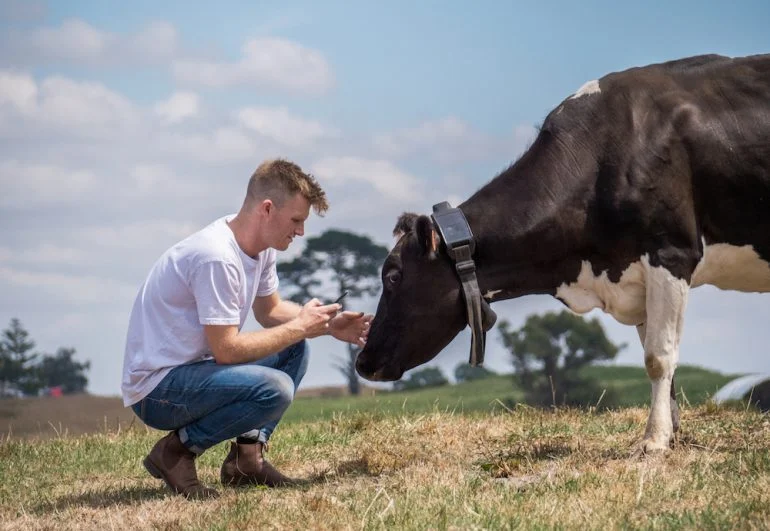
There is a company in New Zealand worth $2 billion right now, and its entire business model sits on one question: where is the cow, and what is it doing?

Not in a research paper. Not in a pilot programme. On 700,000 actual animals, across three countries, generating recurring revenue at $5 to $8 per cow per month, and growing fast enough to attract a funding round led by Peter Thiel at a valuation that most African tech startups will never see.
The company is called Halter. And the moment you understand what it actually builds, the question writes itself: why did someone in Wellington build this before anyone in Lagos, Nairobi, or Accra?
The Product
Halter makes a solar-powered smart collar that goes on a cow. The collar tracks location around the clock, monitors body temperature, chewing activity, health indicators, and breeding cycles, and feeds everything into a proprietary AI system the company calls, with considerable confidence, the “cowgorithm.”
The farmer opens an app, draws a line on a map, and that line becomes the fence. No wire. No posts. No labour. When the animal approaches the boundary, the collar beeps and vibrates. The cow learns, quickly, to turn back.
One tap moves an entire herd to fresh pasture. One tap redirects them to the milking shed. The same dashboard flags which animals are showing early signs of illness before a farmer would notice anything on foot. The infrastructure is entirely software and satellite signal.
The result is a sharp reduction in physical labour, better herd health data than most farmers have ever had access to, and the complete elimination of one of agriculture’s oldest and most expensive physical categories. The fence, as a product, has been replaced by code.
That is what Peter Thiel just bet $2 billion on.
The African Number
Africa has approximately 300 million cattle. Nigeria alone carries between 18 and 22 million animals, putting it among the top five cattle populations on the continent. Ethiopia, Sudan, Tanzania, and Kenya each carry comparable or larger numbers.
Almost none of it is connected to anything.
The average African livestock farmer has no real-time visibility into where their animals are. No early warning system for disease. No fertility cycle data. No way to assess herd health without physically inspecting each animal. No mechanism to move a herd without walking it there, across distances that in many cases run for hours.
African cattle produce significantly less per animal than their counterparts in New Zealand, Australia, or the United States. The gap is partly genetic and partly climatic, but a large portion of it is informational. Decisions are being made without data, and the productivity loss that comes from that costs the continent billions every year in yield, in animal mortality, and in land misuse.
Halter charges $5 to $8 per cow per month to change that. At $5 per animal across just one percent of Nigeria’s herd, that is a $12 million annual recurring revenue opportunity in a single country. Across the continent, the addressable market runs into the billions, and that is before a single line of code is written for African-specific conditions.
The Crisis That Is Also a Market
Nigeria’s herder-farmer conflict is one of the most persistent and economically destructive land-use disputes in sub-Saharan Africa. It has displaced communities, suppressed agricultural investment in affected states, and created a security overhead that costs government, farmers, and businesses real money every year.
At its root, it is a boundary problem. Cattle herders move animals across traditional migration routes. Farmers, responding to population growth and shrinking land availability, have expanded cultivation into those same corridors. Crops get destroyed. Animals get killed. Communities retaliate. And what starts as a land dispute becomes a decade-long crisis with no resolution in sight.
Every policy intervention so far has attacked the politics of the problem without touching the mechanics of it. Grazing reserves were proposed and abandoned. Open grazing bans created new tensions without solving movement. Military deployments treat symptoms.
The actual mechanical problem is this: there is no reliable, trusted, visible boundary that both a herder and a farmer can see in real time and verify independently.
Halter solves exactly that problem. Not as a peace initiative. As a product feature.
A GPS-tracked herd with a digital boundary layer that both the herder and the farmer can view on a phone is not a political solution. It is an infrastructure solution. It turns a dispute about invisible lines into a data question with a verifiable answer. The collar beeps before the boundary is crossed. The farmer’s app shows the herd retreating. The confrontation that would have happened at 2am in a field does not happen.
This is not idealism. It is the same mechanism Halter deploys in New Zealand, where the stakes are financial rather than physical, and it works at 700,000 animals.
The Ground Has Shifted
The connectivity argument against African agri-tech is weakening faster than the conventional wisdom has caught up with. Starlink is live and expanding in Nigeria. MTN and Airtel’s rural network coverage continues to grow. GPS functions wherever there is open sky, which across Nigeria’s pastoral zones is nearly everywhere.
The cost argument is real but it is not fixed. Halter’s current pricing assumes commercially oriented farmers in developed markets. The entry point for a Nigerian deployment sits with the commercial tier: the ranches, the integrated livestock operations, the cooperative federations running hundreds or thousands of animals as an actual enterprise. That segment exists, it is being ignored, and it does not require subsidised pricing to make the numbers work.
From there, pricing adjusts downward as scale builds. Mobile money started with banked urban users and reached the unbanked rural farmer over time. Solar home systems started with middle-income households and are now reaching off-grid communities across the continent. The same route is available here.
On hardware, the argument has shifted. A market that has already welcomed Terra Industries, the Abuja-based robotics startup now operating Africa’s largest drone factory and actively supplying agricultural drones across Nigeria, Ghana, and Kenya, is a market that knows how to receive, maintain, and scale connected hardware. The logistics challenge for smart livestock collars is real. It is not unprecedented.
A $2 Billion Signal
When investors price a company at $2 billion for this category of product, they are not just buying current revenue. They are buying the view that precision livestock technology will become an infrastructure layer the global food system depends on, and that whoever owns that layer in key markets will be worth far more than $2 billion over time.
That view has a geography gap.
The global livestock sector is worth trillions. It is one of the least digitised major industries on earth. It faces growing pressure from climate accountability, food security demands, and the rising expectations of farmers who have watched every other industry transform around them and are still waiting for their version of the smartphone moment.
Africa is not peripheral to that story. The continent has the fastest-growing cattle population in the world, the youngest agricultural workforce, and a livestock base producing well below its potential because it is operating without the tools that Halter just proved the market will pay billions for.
The problem Halter solves is not a New Zealand problem. It was always an African problem. New Zealand built the solution first because it had the infrastructure to de-risk early product development. That is worth acknowledging, but it is not worth dwelling on.
What matters now is that the proof of concept is 700,000 animals across three countries, the blueprint is public, and the $2 billion valuation has pointed a very bright light at a market that Africa is sitting in the middle of.
The question is who builds the African version, and how much longer the answer takes to arrive.