
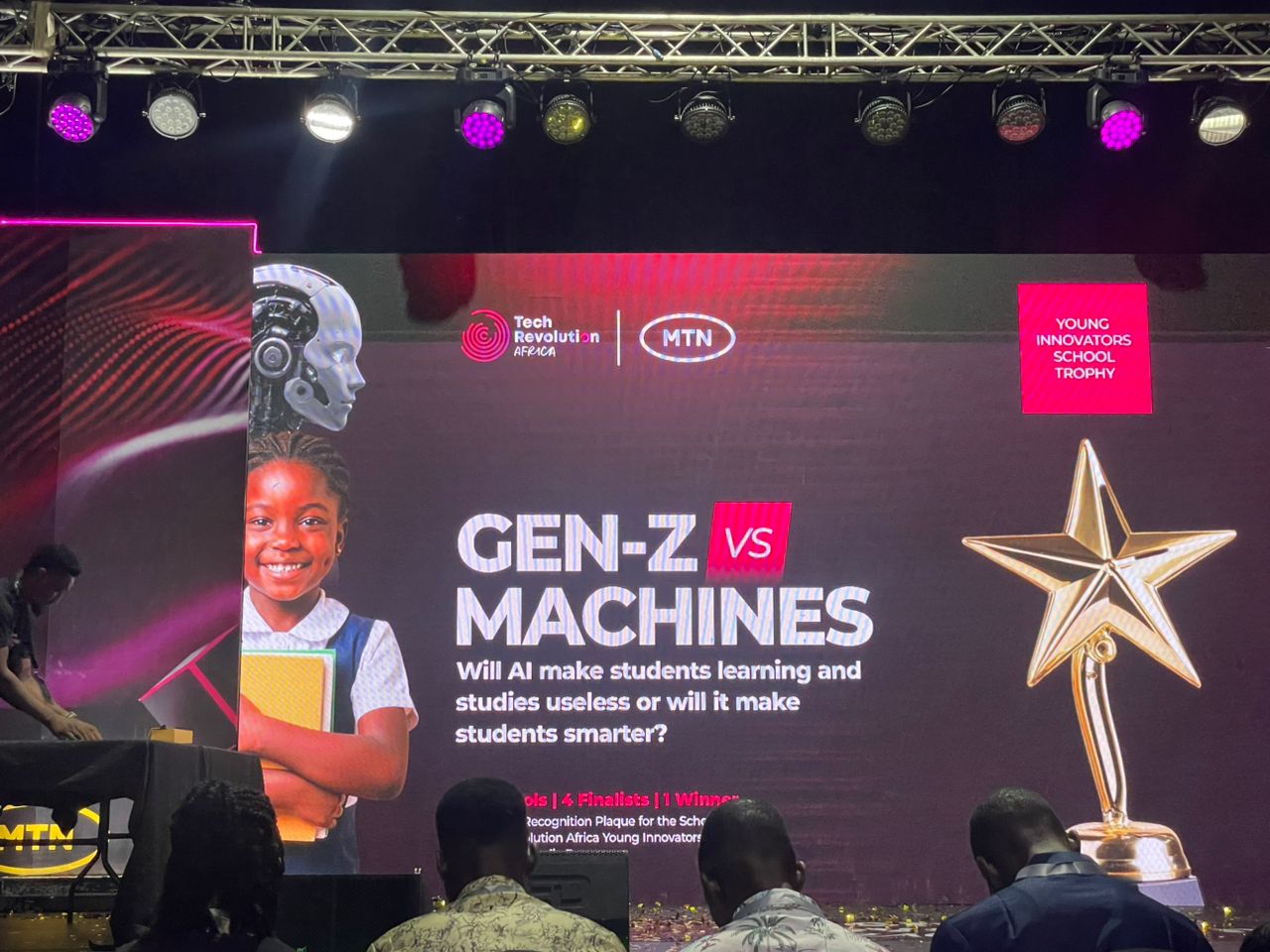
It was the afternoon of the first day of Tech Revolution Africa 2.0, just before the event came to a close for the day, when the Young Innovators Challenge took place. In a room where enterprise leaders and policymakers had spent hours discussing big ideas about technology and the future, secondary school students were brought on stage for a debate.

They called it GenZ vs Machines.
The topic was simple but heavy. Whether or not the use of AI by students for assignments and school work makes learning useless.
I found it fascinating. I already knew that technology and AI had spread far, and that young people were using it too. But listening to teenagers confidently argue about its impact on their own learning made it feel different. This was not second-hand knowledge. They were not guessing. They were speaking from experience.
To me, using AI has always felt like a given. It is an advanced tool. A helper in a fast-paced world. We use it in business as strategists. In writing as editors. In content creation as creatives. Anywhere we need an extra hand, AI is already there.
But watching those students debate raised a question I had not fully considered. What happens when AI falls into the hands of people who have not yet mastered basic arithmetic or foundational skills? Does this same fast-paced tool support learning, or does it take learning away?
The Question I Could Not Ignore
As I listened to the debate, one thought kept returning. AI has become normal for many of us. But children are not adults.
AI seems helpful and is also very convincing. It confidently answers questions, even when the user does not fully understand the question. For students who are still learning the basics, this changes things.

If a student relies on AI before they understand how to think through a problem, what exactly are they learning? Are they building knowledge, or are they only learning how to submit answers?
Hearing Both Sides
Both sides of the debate made points that were hard to ignore.
Those in favour of AI spoke about speed and support. They said AI helps them understand difficult topics, practise more questions, and save time. For students who struggle, it can feel like having a tutor who is always available.
The opposing side pushed back just as strongly. They argued that depending on AI too early removes an important part of learning. Thinking through a problem and making mistakes.
I didn’t feel like one side was completely right and the other completely wrong, but I saw how close both arguments felt to the truth. AI can support learning, but it can also replace it. Especially for students who are still building basic skills.
Where I Actually Stand
For me, AI doesn’t automatically make learning useless. But it shouldn’t be introduced into education without clear boundaries.
The problem is not that students are using AI. The problem is that schools have not clearly defined how it should be used. We cannot pretend that the technology does not exist. And we cannot allow it to do all the thinking either.
There should be balance, and that seems to be what is missing.
The Winners Of The Debate
At the end of the debate, the judges announced the winning team.
Chrisland School took the win. They were supporting the motion that AI made learning useless. And even though part of their win was due to the students speaking more confidently than the others, they made really good points. They were defending thinking. They were pointing to the danger of shortcuts replacing understanding.
The Question We Cannot Avoid
This debate should not end on a stage.
Students are already using AI. That part is settled. The real issue is guidance.
Schools need to decide what learning should look like in a world where answers are easy to get. Teachers need tools, not fear. Parents need to understand that banning technology will not make it disappear.
AI can support learning, and it can also weaken it.
The difference depends on how it is introduced and how much thinking we still expect from students. These students are already living in the future; the question is whether the education system is ready to meet them there.